

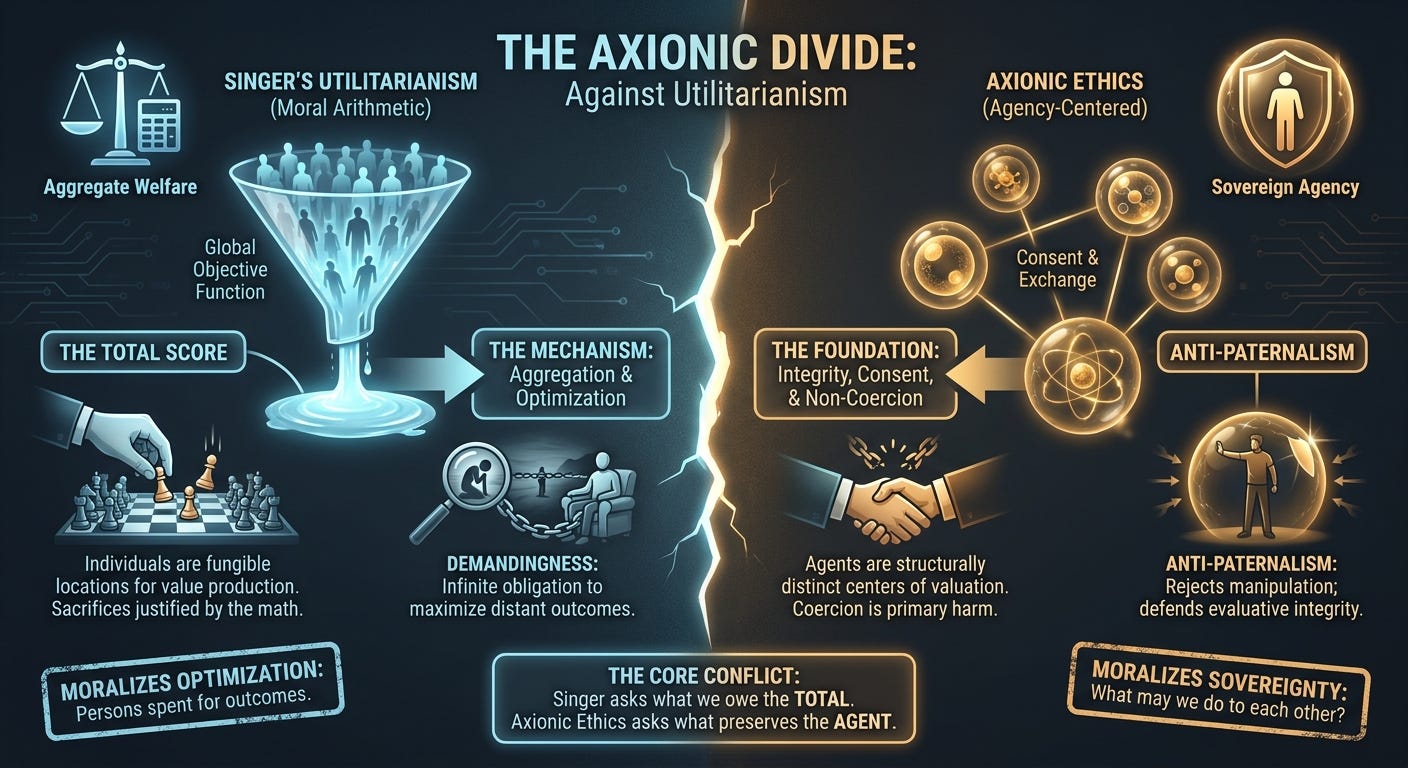
Peter Singer’s utilitarianism sits almost perfectly opposite to Axionic ethics. The two frameworks can occasionally converge on the same practical recommendation, but that is superficial. Their foundations are different. Their units of moral concern are different. Their definitions of harm are different. Their tolerances for coercion are different. Their shape is different all the way down.
Singer begins with welfare. More precisely, he begins with suffering, pleasure, and the impartial aggregation of consequences across all affected beings. The moral question becomes: what action produces the best overall experiential outcome, counted from the standpoint of everyone equally? That question drives the rest of the system. It drives the demand for impartiality. It drives the tendency toward aggregation. It drives the extreme demandingness. It drives the willingness to override local attachments, ordinary ownership, and personal boundaries whenever doing so improves the total.
Axionic ethics begins somewhere else entirely. It begins with agency, coherence, evaluability, consent, and the rejection of coercion. Harm is not defined primarily as a reduction in aggregate welfare. Harm is damage to agency, distortion of evaluative integrity, violation of consent, manipulation of a being as if it were an instrument, or the credible threat of actual harm used to secure compliance. In an Axionic frame, the central moral fact is not that experience can be scored and summed. It is that agents exist as structured centers of valuation and action, and that any ethical system that treats them as interchangeable containers for utility has already committed the basic philosophical error.
Aggregation
That is the first major fracture line: aggregation. Singer’s framework requires it. One person’s losses can be justified by another person’s gains if the overall result is sufficiently positive. This is not some peripheral detail. It is the engine of utilitarianism. Once aggregate welfare becomes the master variable, individuals cease to matter as sovereign centers of value and become locations where value can be produced, reduced, traded, or sacrificed. Singer would resist that formulation, of course. He would say that utilitarianism takes everyone seriously by counting everyone equally. The problem is that counting everyone equally in an aggregate calculus is precisely what makes everyone fungible. The structure is egalitarian at the level of arithmetic and annihilating at the level of personhood.
Singer’s shift from preference utilitarianism toward hedonic utilitarianism only sharpens the problem. Preference utilitarianism at least leaves some room for agency, authorship, and consent to matter as part of what is being optimized. Hedonic utilitarianism strips the moral currency down further. What finally matters is pleasure and suffering. Agency then survives, if at all, as an instrument for producing better experiences. From an Axionic standpoint, that is not a refinement. It is a cleaner statement of the reduction.
Axionic ethics rejects that move. Agents are not buckets of welfare. They are not entries in a moral spreadsheet. They are not morally dissolvable into a global objective function. A moral framework that authorizes the sacrifice of one agent’s sovereignty for the sake of a sufficiently large total elsewhere has not discovered compassion. It has discovered an accounting trick.
Demandingness
The second fracture line is demandingness. Singer is famous for pushing utilitarianism toward its most severe implications. If you can prevent suffering at relatively little cost to yourself, you are morally required to do so. If you can continue making sacrifices to improve distant lives more than your own expenditures improve your own, the demand persists. This logic can be softened rhetorically, but it cannot be escaped without weakening the theory. Once aggregate welfare is the criterion, every retained luxury becomes morally suspect. Every local preference stands under permanent indictment. Every asymmetry between what you could give and what you do give becomes a potential moral failure.
From an Axionic standpoint, this is not ethical seriousness. It is a category error masquerading as moral rigor. The existence of need elsewhere does not automatically generate a claim on your agency. It may generate an opportunity for charity, solidarity, alliance, or voluntary aid. Those are real and often admirable. What it does not generate is a universal mortgage on the lives of other agents. Singer’s framework turns beneficence into standing obligation because it begins by assuming that value is globally aggregable and impersonally rankable. Axionic ethics denies both premises.
Coercion
This connects directly to coercion, which is where the conflict becomes politically explosive. Singer’s framework tends naturally toward redistribution. If resources can be extracted from some and reallocated in ways that produce more welfare for others, utilitarianism will usually regard that as morally justified and often morally required. The state becomes a tool for outcome optimization. The fact that coercion is involved is morally secondary. It is regrettable perhaps, costly perhaps, but still instrumentally legitimate within the calculus.
Axionic ethics treats coercion very differently. Coercion is not just another input on the cost side of the ledger. It is itself a morally salient kind of harm: the credible threat of actual harm used to gain compliance. That matters because coercion directly attacks agency. It forces alignment through fear, dispossession, or domination rather than through consent, persuasion, exchange, or voluntary cooperation. Any ethic that treats coercion as a routine instrument of moral optimization has already subordinated agents to outcomes. That is not a minor policy disagreement. It is a foundational divergence about what ethical violation even is.
Utilitarians sometimes reply that strong protections for rights, property, consent, and family attachment can be defended instrumentally because they tend to produce better outcomes in the long run. That reply does not dissolve the conflict. It restates it. Under utilitarianism, agency is still derivative. It is protected when useful, relaxed when inconvenient, and overridden when the numbers become large enough. Axionic ethics rejects that status entirely. Agency is not a helpful heuristic inside a welfare machine.
Impartiality
Singer’s utilitarianism also depends on a very strong form of impartiality. The standpoint it seeks is often described as the point of view of the universe. Your child, a stranger, and a distant population are all meant to count in fundamentally the same way. Particular attachments are morally permissible only under constraint. Left to themselves, they look suspiciously like bias. The theory pushes toward a view in which personal commitments are always in danger of appearing ethically provincial.
Axionic ethics has no interest in this fantasy of view-from-nowhere moral cognition. Agents are situated. They have histories, commitments, identities, projects, relationships, and bounded spheres of authority. These are not contaminants to be scrubbed out by moral mathematics. They are part of the actual structure of agency. A father’s special concern for his child is not a local irrationality that needs justification before an impartial tribunal. It is one of the ways agency manifests in the world. A framework that trains people to distrust every thick human attachment unless it can be defended in aggregate welfare terms is not elevating ethics. It is thinning out the moral world until only arithmetic remains.
Moral Realism by Stealth
There is a deeper metaphysical issue underneath all this. Singer writes as though suffering and flourishing generate reasons that are objective, impersonal, and universally binding. His utilitarianism may be framed in secular terms, but structurally it inherits the ambition of moral realism. The world contains morally relevant states. Those states impose demands. Ethical thought consists in properly recognizing and maximizing the good across all affected beings.
That is alien to Axionic thought. Value is not a substance in the furniture of the universe. It does not hang over reality issuing commands. Values are agent-bound. They arise within evaluative structures. They are interpreted, held, enacted, revised, and defended by agents under conditions. This does not make ethics arbitrary. It makes ethics conditional, structured, and real at the level where real valuation actually occurs. Singer’s system tries to leap over this layer by turning suffering into a universal currency of obligation. Axionic ethics regards that move as philosophical smuggling. It imports objectivity through the back door and calls the result compassion.
The Axionic rejection of coercion does not require treating agency as a mystical substance with objective cosmic sanctity. The point is structural. A system that normalizes domination, forced compliance, or epistemic capture destroys the conditions under which agents can remain evaluable as agents at all. The prohibition is constitutive of inter-agent order, not a borrowed relic of moral realism.
Population Ethics
The conflict becomes even sharper once population ethics enters the frame. Utilitarianism is notoriously vulnerable to repugnant conclusions, replacement logic, and the tyranny of large numbers. Enough tiny welfare increments can outweigh severe harms. Enough barely positive lives can dominate fewer excellent ones. Enough aggregate gain can justify almost anything if the arithmetic runs long enough. These are not accidental embarrassments. They reveal what happens when you reduce ethics to scalar optimization over a sufficiently large domain.
Axionic ethics resists this because it does not treat moral reality as a maximization problem over an impersonal total. Actual agency matters. Actual consent matters. Actual evaluative structures matter. You do not get to swamp violations of agency by piling up enough remote utility dust. You do not get to erase coercion by multiplying beneficiaries. You do not get to transmute domination into righteousness by enlarging the denominator.
Manipulation and Paternalism
This also explains why Axionic ethics is far more hostile to paternalism and manipulation. A utilitarian can justify deception, censorship, nudging, or forced compliance when the expected consequences look favorable enough. This is always the temptation of consequentialist moral systems: once outcomes govern, process becomes negotiable. Autonomy remains valuable only insofar as it tends to produce better consequences. When it does not, it becomes expendable.
Hedonic utilitarianism makes this danger even clearer. If what finally matters is the balance of felt experience, then deception, sedation, managed belief, or coerced benevolence can become easier to justify whenever they improve the aggregate hedonic result. An ethic centered on pleasure and suffering has fewer internal resources for treating agency as intrinsically significant. From an Axionic standpoint, that is not compassion made rigorous. It is paternalism with better branding.
Axionic ethics treats epistemic distortion itself as anti-agentic harm. To deceive someone for their own good is still to invade their evaluative process. To manipulate their beliefs for a socially beneficial end is still to treat them as a substrate to be managed. To paternalize them because your model says the aggregate result is better is still to override their status as a center of valuation. Singer’s framework is structurally drawn toward benevolent managerialism. Axionic ethics treats that managerial impulse as a recurring moral pathology.
Two Different Questions
At this point the contrast can be stated cleanly.
Singer asks: what action maximizes aggregate welfare across all affected beings, counted impartially?
Axionic ethics asks: what preserves or violates agency, evaluability, consent, and non-coercive order among agents?
These are not two versions of the same ethical project. They are rival conceptions of what ethics is about.
Postscript
That is why the occasional overlap in policy tells us very little. Both frameworks can condemn cruelty. Both frameworks can support voluntary charity. Both frameworks can favor institutions that reduce misery and improve human flourishing. But the agreement is unstable because the reasons are different. Singer supports these things because they improve the total. Axionic ethics supports them when they preserve or enlarge agency without violating consent or legitimizing coercion. Once the background conditions change, the divergence reappears immediately.
Singer’s utilitarianism moralizes optimization. Axionic ethics moralizes sovereignty.
Singer sees the ethical world as a field of sentient welfare to be improved from an impartial vantage. Axionic ethics sees it as a world of agents whose integrity cannot be collapsed into a single score. Singer asks what we owe the total. Axionic ethics asks what we may do to each other. Singer is willing to spend persons for outcomes. Axionic ethics treats that willingness as the central warning sign.
This is why Singer’s moral seriousness so often produces conclusions that feel monstrous to anyone who still takes agency seriously. The monstrosity is not incidental. It comes from the structure of the theory. Once morality becomes aggregate optimization, persons are always in danger of being outvoted by arithmetic.
That is the Axionic divide. It is not a disagreement over charitable tone or policy emphasis. It is a disagreement over whether moral thought should begin with welfare totals or with sovereign agents. Once that choice is made, much else follows.