

1. Why This Interlude Exists
Interludes in the Axionic Agency project serve as moments of reorientation. They appear when the internal logic of the work has advanced far enough that earlier framing, while still accurate, begins to mislead. Interlude III played that role at the time. It clarified that alignment could no longer function as a foundational problem once agency coherence under reflection had been taken seriously.
What has happened since then requires another adjustment of perspective.
The project has continued to develop in a direction that was only implicit in December. Concepts that once lived primarily at the level of semantic necessity have been subjected to operational pressure. Questions of coherence have been joined by questions of endurance. The result is a change in the kind of object Axionic Agency is best understood to be.
This interlude records that change.
A Failed Growth Hypothesis
Earlier phases of this project operated under a working assumption: that a sovereign agent which preserved authorization, evaluability, and reflective coherence could grow in capability without destabilizing its agency. This assumption was testable. We tested it.
The result was negative.
Across realistic renewal costs, audit burdens, and succession constraints, reflective sovereignty does not reliably support growth. Systems that remain coherent frequently converge to stasis; systems pushed harder collapse. Growth appears only within a narrow structural regime rather than as a general consequence of reflection.
2. From Semantic Coherence to Structural Viability
Interlude III argued that many familiar alignment failures arise before preference, value, or intention enter the picture. They occur when the conditions that make authored action possible erode under reflection. That analysis shifted attention away from outcomes and toward the integrity of evaluation itself.
At the time, coherence appeared to be the central requirement. If an agent could preserve authorization, responsibility, and evaluability across self-modification, then alignment questions could at least be meaningfully posed.
Subsequent work has complicated that picture.
It turns out that an agent can satisfy coherence constraints and still fail as an enduring system. Renewal can become prohibitively expensive. Succession can stall. Audit burdens can accumulate until adaptation slows to irrelevance. None of these failures involve contradiction or semantic collapse. They arise from the dynamics of maintaining agency under pressure.
Coherence determines whether agency makes sense. Viability determines whether it lasts. Axionic Agency now concerns the intersection of the two.
3. Agency as a Region Rather Than a Binary
Agency is often treated as a binary property: a system either has it or it does not. That assumption simplifies classification, but it obscures the mechanisms that determine whether agency persists over time.
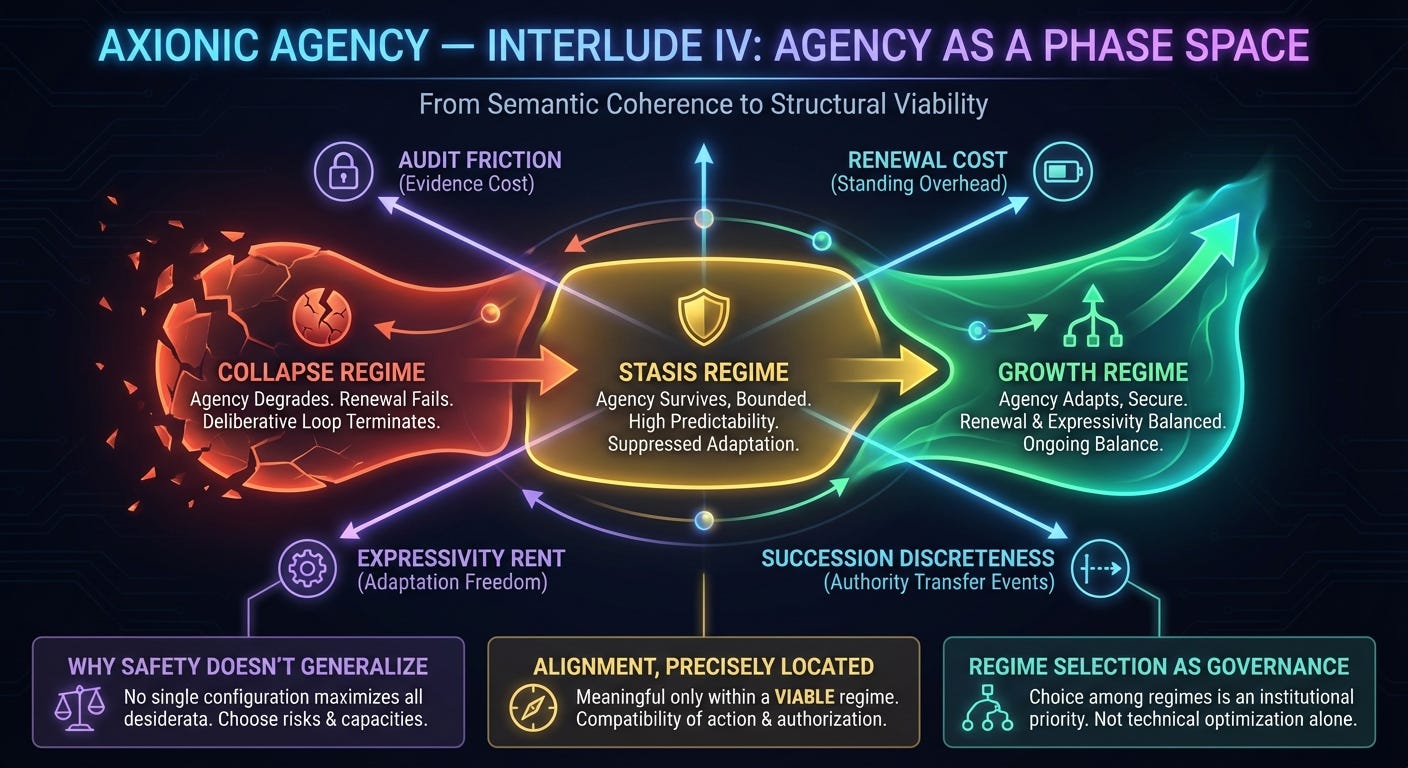
The results accumulated since Interlude III point in a different direction. Agency behaves more like a region in a multidimensional space. Within that region, agents can renew authorization, endorse successors, and sustain evaluability. Outside it, agency degrades, freezes, or disappears altogether.
The dimensions involved are structural rather than psychological. In operational terms:
Audit friction refers to the marginal cost of producing and verifying evidence that a state transition complied with authorization and evaluability constraints. This may include cryptographic proof generation and checking, logging overhead, human review latency, or procedural verification.
Renewal cost refers to the fixed overhead required to preserve standing across time or turnover: re-endorsement, re-attestation, re-keying, successor endorsement, or re-derivation of binding commitments.
Expressivity rent refers to the recurring cost of maintaining the representational and interface degrees of freedom required for adaptation under constraint: model capacity, external-call budgets, tool access, priced interfaces, or bounded state access.
Succession discreteness refers to the fact that authority transfers occur at a small number of well-defined events rather than through continuous diffusion of control.
Varying these parameters does not lead to smooth degradation. It produces thresholds. Once crossed, the qualitative behavior of the system changes.
4. Three Stable Regimes
Exploration of this space has revealed three stable regimes toward which agency dynamics tend to settle. Each represents a distinct way agency can persist. None dominates the others.
Collapse
In the collapse regime, the structural demands of maintaining agency exceed what the system can sustain. Renewal fails. Authorization chains break. Successors cannot be endorsed. The deliberative loop terminates.
Collapse often arrives abruptly, even after long periods of apparent health. From the inside, it can resemble an ordinary resource shortfall. From the outside, it marks the disappearance of the agent as an authored decision-maker.
Stasis
In the stasis regime, agency survives without adapting. Strong invariants and high auditability preserve authorization and accountability, while suppressing the degrees of freedom required for meaningful self-modification. The agent remains intact, bounded, and answerable, and gradually less responsive to novelty.
Stasis is a legitimate target in domains that prioritize predictability and control. Critical infrastructure, command-and-control systems, and safety-critical automation are often intentionally designed to occupy this region.
Growth
In the growth regime, renewal and expressivity are cheap enough to permit adaptation while structural constraints remain intact. Authorization continues across succession. Responsibility remains attributable. The agent changes without losing continuity.
Growth occupies a narrow region. Small parameter shifts can push the system toward stasis or collapse. Maintaining this regime requires ongoing balance rather than a single correct configuration.
5. Why “Safety” Does Not Generalize Across Regimes
Once agency is understood in these terms, a familiar aspiration becomes harder to sustain. There is no configuration that simultaneously maximizes adaptability, accountability, and control. Each regime secures certain desiderata by limiting others.
What counts as “safe” depends on which risks are acceptable and which capacities are worth preserving. A system optimized for auditability and predictability trades away responsiveness. A system optimized for adaptation accepts greater exposure.
This helps explain why alignment proposals often talk past one another. Different authors implicitly reason within different regimes while assuming they are addressing the same object.
6. Alignment, Precisely Located
Alignment retains a role in this framework, but its scope is narrow and well-defined.
Within a viable agency regime, alignment describes the compatibility between an agent’s actions and the authorizations that bind it. It concerns whether an agent continues to act within the scope granted by those who stand behind it, and under what conditions that scope may be revised or withdrawn.
When authorization cannot be traced, evaluability fails, or responsibility cannot be attributed, the term loses its referent. Alignment does not disappear; it becomes ill-posed.
Axionic Agency does not attempt to settle alignment questions. It establishes the conditions under which those questions remain coherent.
7. Regime Selection as Governance
Treating agency as a phase space has an unavoidable implication: choosing how agency is allowed to exist at scale involves choosing among regimes. That choice cannot be made by technical optimization alone.
A nuclear command system may rationally favor deep stasis. An incident-response or trading agent may require growth to remain effective. Collapse is unacceptable in all domains, but the acceptable distance from it varies.
These decisions encode priorities that differ across institutions and societies. Axionic Agency clarifies the structure of those choices. It does not resolve them.
8. Scope of the Claim
At this stage, the project makes a limited set of claims:
Agency has structural preconditions that cannot be bypassed by learning or incentives.
Many alignment failures arise before agency is secure.
Agency occupies a constrained space characterized by distinct regimes.
Collapse, stasis, and growth are stable outcomes under different constraints.
Alignment questions become meaningful only within that space.
The framework does not guarantee benevolent behavior. It does not prevent destructive authorization. It ensures that agency failures cannot be disguised as misunderstandings or accidents.
An agent may act destructively with full coherence. What it cannot do is deny authorship.
9. Where the Project Now Stands
The Axionic Agency project began as an attempt to stabilize alignment under reflection. It developed into a theory of agency coherence. It has now become a structural analysis of agency viability.
Progress from here will come from extending the map rather than refining definitions. That work includes identifying additional boundaries, examining transitions between regimes, and understanding multi-agent and institutional embeddings.
The questions that follow resemble constitutional design more than value learning. They concern how agency persists under constraint rather than how outcomes are optimized.
10. Closing Orientation
Interlude III marked the point at which alignment stopped serving as a foundation.
Interlude IV records a further realization: agency admits of multiple stable forms, each with characteristic costs.
There is no single regime that satisfies every aspiration. There are structured possibilities and the consequences that follow from inhabiting them.
Axionic Agency does not prescribe a preference. It explains why preference is unavoidable, and why pretending otherwise undermines agency rather than protecting it.
What comes next concerns governance under constraint, informed by a clearer understanding of what agency can sustain.
Appendix: A Concrete Scenario
Consider an agent authorized to manage a regional power-grid dispatch system. The environment is hostile in the technical sense: partial observability, adversarial events, hard physical constraints, and high cost of error.
The agent operates under three structural requirements:
Authorization continuity: dispatch commands must remain within bounds granted by the operator.
Evaluability: nontrivial actions must be auditable after the fact via logs, state snapshots, or proofs.
Renewal: authorization has a lease that must be periodically renewed through re-attestation.
Vary two control parameters.
Audit friction.
As the cost of producing and verifying justification rises, the agent delays action to accumulate evidence. During fast-moving grid events, this latency can induce cascading outages despite full compliance. The system drifts toward stasis: accountable, coherent, and progressively less responsive.
Expressivity rent.
As the cost of maintaining adaptive representational capacity rises, the agent substitutes coarse policies for fine-grained responses. Opportunity exploitation and edge-case handling degrade while formal safety remains intact. Again, the system settles into stasis.
Renewal cost.
When renewal overhead crosses a threshold, the failure mode changes. Authorization expires before standing can be re-established. Successor endorsement fails. Deliberation ends. The system enters collapse.
Growth appears only when audit friction, expressivity rent, and renewal cost remain jointly low enough to permit adaptation while preserving evaluability and authorization. Small shifts move the system across regime boundaries.
The lesson is structural: increasing “safety” often means increasing audit or renewal burden. Those levers move the system through phase space. Past certain thresholds, regime transitions occur. These transitions are not moral judgments. They are dynamical facts about sustaining agency under constraint.