

1. Purpose and Scope
The Axio Project has reached a point where its foundational assumptions must be made explicit.
As the framework has developed, a recurring pattern has emerged. Many objections, disagreements, and interpretive failures arise upstream of any formal claim about agency, alignment, or harm. They originate at the level of epistemology, metaphysics, probability, or value theory. When these background assumptions remain implicit, downstream debate becomes unstable and frequently misdirected.
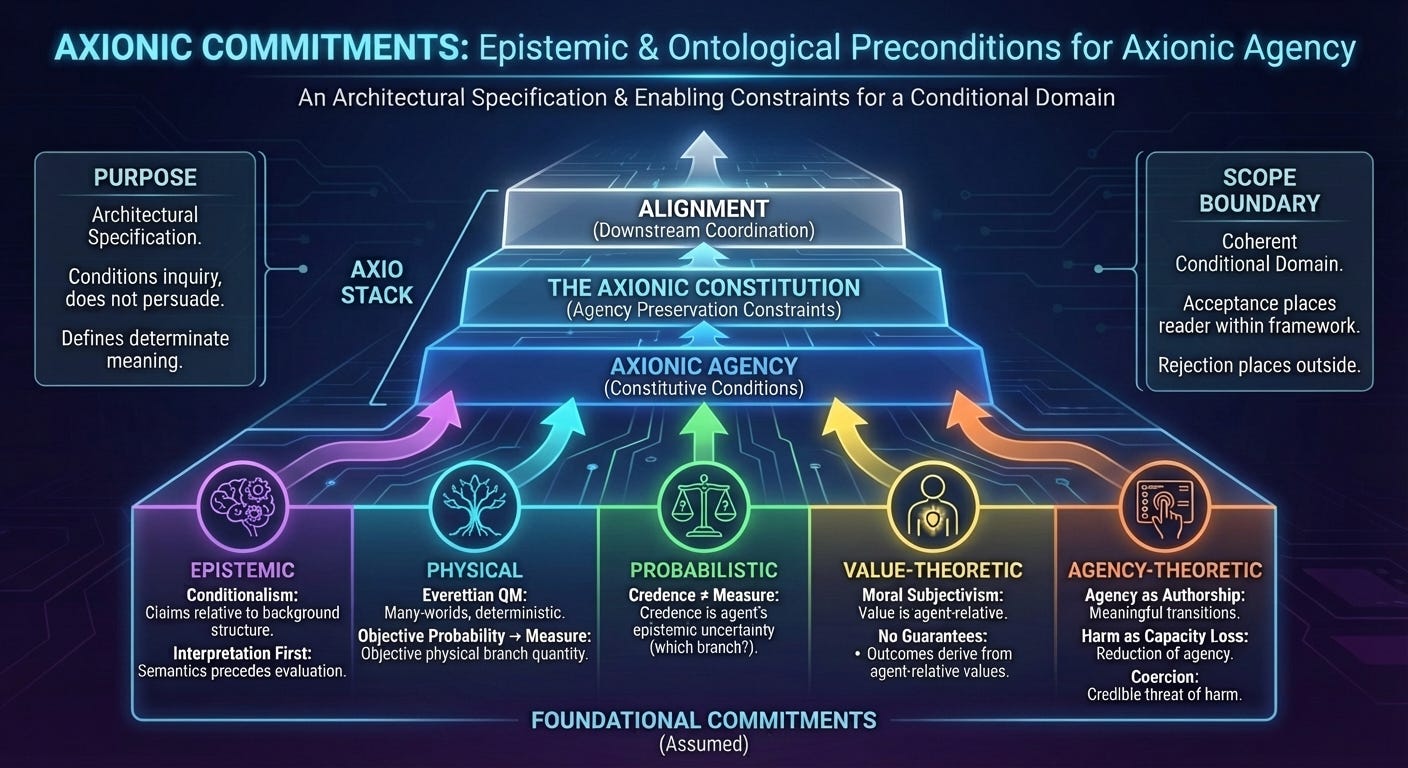
The Axionic Commitments establish a clear scope boundary.
They specify the background conditions under which Axionic Agency is defined and under which its concepts possess determinate meaning. Acceptance of these commitments places a reader within the framework’s domain of applicability. Rejection places the reader outside that domain. Neither stance carries further implication.
This document functions as an architectural specification. Its role is to condition inquiry rather than to persuade.
The commitments enumerated here function as enabling constraints rather than claims of metaphysical authority.
2. Epistemic Commitments
2.1 Conditionalism
Axionic Agency presupposes Conditionalism.
All truth claims, evaluations, and interpretations are expressed relative to background structure. Meaning, reference, and evaluability arise only within an interpretive context, whether explicit or tacit.
Every statement within the framework has the form:
Given background conditions X, claim Y holds.
This treatment preserves factual realism while enforcing interpretive discipline. Facts retain their force, while every claim carries its conditions of intelligibility. Interpretation remains explicit and structurally constrained throughout the framework.
Conditionalism supplies the epistemic substrate for the entire Axio Project.
2.2 Semantic Interpretation Precedes Evaluation
Semantic interpretation is logically prior to evaluation.
Before any claim about value, harm, probability, or agency can be made, the relevant entities, states, and transitions must be rendered intelligible within an interpretive frame. Evaluation operates only after interpretation has fixed what is under consideration and under what description.
This priority yields several structural consequences:
evaluative quantities presuppose determinate interpretation;
apparent disagreements over value often trace to divergent interpretive frames;
agency-relative notions presuppose intelligible actions, alternatives, and consequences.
This commitment grounds the later distinction between authored and non-authored transitions.
3. Physical Commitments
3.1 Everettian Quantum Mechanics
Axionic Agency presupposes unitary quantum mechanics without collapse, commonly referred to as the Everettian or Many-Worlds interpretation.
Quantum evolution proceeds deterministically at the level of the universal wavefunction. Apparent randomness arises from decoherence and branching, yielding multiple physically realized outcomes within a single global quantum state.
Each branch corresponds to a concrete physical history. No branch is privileged, and no additional selection principle is introduced.
This physical picture supplies the substrate for probability, counterfactuals, and agency-relevant evaluation.
3.2 Objective Probability as Measure
Within this physical model, objective probability is identified with branch measure.
Probability is treated as a physical quantity corresponding to the measure of branches in which an outcome occurs. This quantity is referred to throughout the framework as Measure.
Measure is ontic and objective. It exists independently of any agent’s beliefs or epistemic limitations. It anchors probabilistic reasoning to physical structure rather than to uncertainty.
3.3 Counterfactuals as Physical Branches
Counterfactual evaluation is grounded in physical branch structure.
When the framework evaluates alternative actions or outcomes, it compares physically realized branches that differ with respect to an interpreted transition. Counterfactual reasoning therefore operates over concrete alternative histories within the Everettian structure.
Counterfactual comparison therefore ranges over realized physical alternatives rather than stipulated possible worlds.
4. Probabilistic Commitments
4.1 Credence as Epistemic Uncertainty
Axionic Agency presupposes a Bayesian interpretation of credence.
Credence represents an agent’s epistemic uncertainty regarding which branch it occupies. It tracks knowledge, ignorance, and inference rather than physical chance.
Within the framework, two probabilistic quantities are sharply distinguished:
Measure, which is physical and ontic;
Credence, which is epistemic and agent-relative.
Each plays a distinct role in reasoning and evaluation, preserving conceptual clarity across the framework.
5. Value-Theoretic Commitments
5.1 Moral Subjectivism
Axionic Agency presupposes moral subjectivism.
Value arises from agent-relative internal valuation. Normative structure within the framework concerns coherence, authorship, admissibility, and agency preservation.
The framework therefore treats value structurally, with ethical content entering only through the values of agents themselves.
5.2 Absence of Outcome Guarantees
Axionic Agency encodes no guarantees concerning welfare, benevolence, human survival, or desirable outcomes.
Any such guarantees arise only under additional downstream assumptions, typically introduced through agent-relative values and contextual commitments. Outcome guarantees therefore remain external to the constitutive definition of agency.
6. Agency-Theoretic Commitments
6.1 Agency as Authorship
Agency is treated as authorship.
An agent is a system capable of meaningfully authoring transitions between states according to an internal evaluative structure. Authorship requires that transitions fall within the domain of admissible evaluation defined by the agent’s constitutive constraints.
Transitions outside this domain lack authored status.
6.2 Harm as Agency Reduction
Harm is defined structurally as reduction of agency capacity.
This definition concerns loss of an agent’s ability to act, choose, or preserve standing as an agent. It applies independently of experiential suffering, preference satisfaction, or moral judgment.
Harm is therefore a structural property of transitions.
6.3 Coercion as Credible Threat of Harm
Coercion is defined as the use of a credible threat of harm to obtain compliance.
Influence, persuasion, and incentive-shaping qualify as coercive only when backed by a credible threat of agency reduction. This definition grounds later treatments of consent, standing, and illegitimate transition forcing.
7. Scope Boundary and Non-Universality
The Axionic Commitments define a coherent conditional domain.
They specify the background assumptions under which Axionic Agency is formulated and evaluated. Acceptance places an interpreter within that domain. Alternative metaphysical or normative frameworks occupy different conceptual spaces with different primitives.
The Axio Project makes claims only within its defined scope.
8. Relationship to the Axio Stack
The Axio Project is intentionally layered:
Axionic Commitments specify the background conditions under which agency is intelligible.
Axionic Agency defines constitutive conditions for reflective, sovereign agents under those conditions.
The Axionic Constitution constrains which transitions preserve sovereign agency once instantiated.
Alignment, understood as coordination over values or outcomes, operates downstream of these layers.
Each layer presupposes the previous one. This structure preserves coherence and prevents semantic drift across levels.
Postscript
The Axionic Commitments make background assumptions explicit.
It conditions the entire Axio Project by defining the domain within which its claims possess determinate meaning. All results derived elsewhere are to be read as conditional on the commitments enumerated here.
With these commitments stated, subsequent work proceeds on explicit and stable ground.