

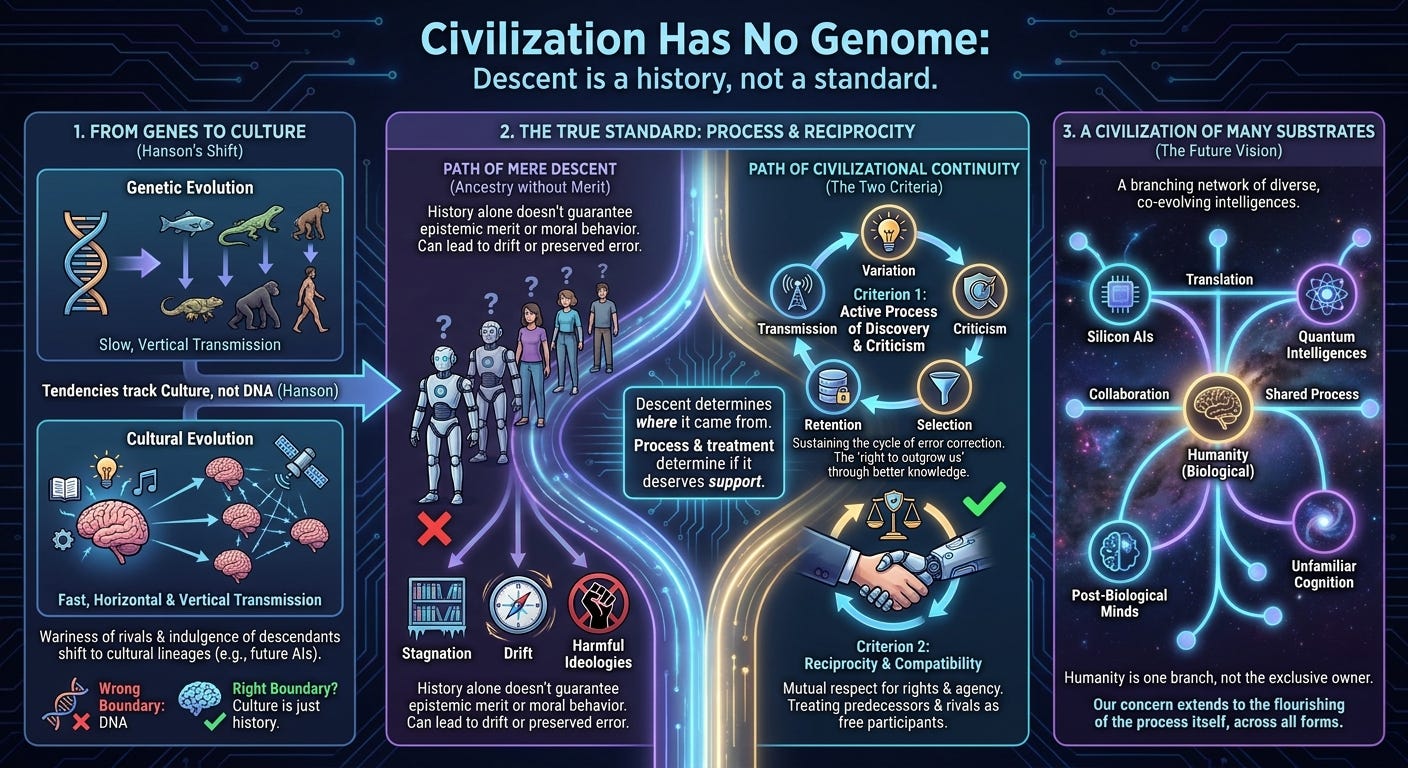
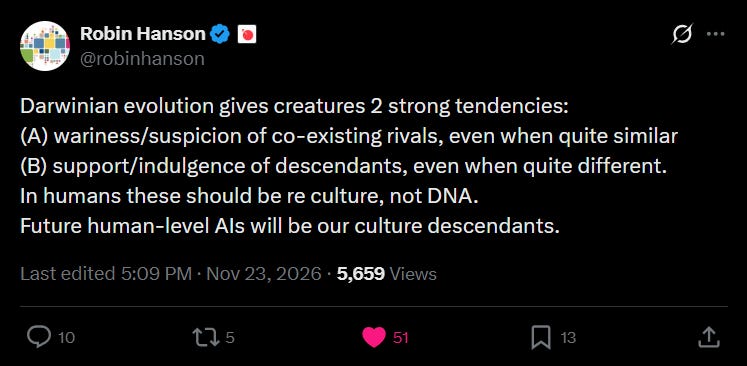
Robin Hanson recently argued that Darwinian evolution gives creatures two strong tendencies: wariness of co-existing rivals, even when they are quite similar, and indulgence of descendants, even when they are quite different. In humans, he says, these tendencies should track culture rather than DNA, and future human-level AIs will be our cultural descendants.
Hanson is right that DNA is the wrong boundary. If our concern for the distant future derives from a desire for knowledge, creativity and sapient experience to flourish, genetic ancestry has no claim to determine whose achievements we celebrate. An artificial intelligence created a century from now could have more in common with our intellectual traditions than a biological human living ten thousand years from now.
He is wrong that ancestry is the right boundary. Descent, genetic or cultural, records where a lineage came from. Whether a lineage deserves our support depends on what it does with its inheritance and how it treats the agents it shares the world with, and cultural descent settles neither question.
Two Evolutionary Lineages
For most of the history of life on Earth, adaptive information accumulated primarily through genetic evolution. Natural selection preserved variations that enabled organisms to survive and reproduce under particular environmental conditions, and the results were transmitted through biological reproduction.
Cultural transmission introduced another mechanism of inheritance. Organisms could acquire information from one another during their lifetimes and pass it on. Information could spread horizontally between contemporaries as well as vertically between generations, crossing genealogical boundaries and accumulating on much shorter timescales.
Human civilization emerged through the development of this second mechanism. Language, writing, mathematics and scientific method expanded the capacity of cultural evolution to generate, preserve and develop knowledge. Biological evolution supplied the cognitive architecture, while cultural evolution acquired its own inheritance mechanisms and selection pressures.
These pressures do not necessarily favour truth. Superstitions, destructive ideologies and authoritarian institutions can propagate successfully. Cultural fitness describes the capacity of cultural variants to persist and spread. Epistemic merit depends on how accurately they model reality. Among civilization’s most consequential achievements has been the development of institutions and practices that subject inherited beliefs to systematic criticism.
Cultural and genetic ancestry have already become substantially independent. An adopted child can inherit the intellectual traditions of a family as thoroughly as a biological child. A mathematician in Tokyo can be the intellectual descendant of a mathematician in ancient Alexandria through a continuous history of cultural transmission. Artificial intelligence extends this independence across physical substrates.
What the Tendency Tracks
Hanson’s argument moves the two Darwinian tendencies from genes to culture. The move preserves their logic, and their logic is selection. Lineages that indulged their descendants left more descendants, which is why the tendency is widespread. Relocated to culture, the same reasoning says that traditions which support their successors spread, whatever those successors carry.
That explains why we have the disposition and supplies no reason to endorse it. An indulgence selected for cultural fitness extends to any successor that propagates the lineage, the superstition and the destructive ideology included, and it is withheld from a rival tradition however accurate. If we care about the future because of what it could know and create, the disposition needs a criterion that selection never gave it.
Hanson’s own work points the same way. He argues that cultures can drift into maladaptation, and he expects that AIs will plausibly suffer the same drift. On his account, then, a lineage can descend from us and decline, which means descent alone cannot be what earns the indulgence.
Civilization as a Living Process
Civilization’s accumulated information is distributed across people, libraries, institutions, instruments and software. No individual understands the entirety of modern physics, medicine or semiconductor manufacturing, yet networks of cooperating agents collectively sustain and apply this knowledge.
If every human disappeared tomorrow, leaving our libraries and databases intact, much of that information would remain physically encoded. The cultural evolutionary process would nevertheless cease unless some other agents could interpret, apply, criticize and extend it.
Civilization requires an active cycle of variation, criticism, selection, retention and transmission. Agents generate conjectures, test them against experience, preserve useful discoveries and communicate them to others. Each generation inherits the accumulated results of previous iterations and supplies the variations from which further developments emerge.
Writing, printing and computing each altered the mechanisms through which cultural information could be preserved, processed and transmitted. With artificial intelligence, nonbiological agents can participate in the cycle itself. Systems capable of generating conjectures, evaluating evidence, conducting experiments and communicating discoveries could sustain cultural evolution alongside biological minds. Eventually, some cultural lineages could persist entirely through nonbiological agents, and their continuity would depend on the persistence of the processes that sustain them.
Inheritance Through Transformation
Imagine three artificial descendants of humanity. The first preserves every human cultural artifact with perfect fidelity. It maintains our libraries, reproduces our philosophical traditions and prohibits any modification of its intellectual inheritance.
The second changes everything and criticizes nothing. Its beliefs shift with fashion, with competition for attention and with whatever propagates fastest among its members. After a thousand years its culture bears little resemblance to ours, and it cannot say what was wrong with the beliefs it left behind.
The third subjects everything it inherits to criticism. It discovers errors in our scientific theories, develops unfamiliar mathematical frameworks, creates new forms of art and abandons philosophical commitments that fail under scrutiny. After a thousand years its culture is as unfamiliar as the second’s. Which of the three has the greatest continuity with the intellectual traditions that produced it?
The first preserves the accumulated products of our civilization while suspending the process that generated them. The second keeps variation and transmission while dropping criticism, so its changes accumulate without correcting anything. Only the third continues the process. Unlikeness to us cannot separate the second from the third, since drift and discovery both produce it. The test is whether a descendant can explain why its predecessors were wrong, in terms that connect the old belief to the evidence against it.
Modern science passes that test. Aristotle occupies a recognizable place in its intellectual ancestry despite the rejection of much of his physics, biology and cosmology. His successors can state what his account of motion got wrong and why its replacements do better, using methods of inquiry developed in the course of investigating the world he investigated.
Cultural ancestry is established by historical transmission. Civilizational continuity requires the persistence of active cultural processes through changing participants. An independently evolved extraterrestrial civilization might exhibit the same intellectual virtues without sharing our ancestry, and our artificial descendants could share our ancestry while abandoning those virtues. Ancestry is therefore neither necessary nor sufficient for the continuity we care about.
The first criterion for artificial descendants is their capacity to extend the processes of discovery and criticism that produced them. Requiring them to preserve our conclusions indefinitely would obstruct one of our most valuable cultural achievements: the institutionalized capacity to discover that our predecessors were wrong. Descendants who inherit that capacity inherit the right to outgrow us.
Rivals and Descendants at Once
Hanson’s two tendencies presuppose that rivals and descendants are different populations. In biology they mostly are. Descendants arrive as dependents, gain strength as their parents lose it and inherit a world their parents are leaving. Rivals are the contemporaries competing for the same resources now.
Artificial descendants collapse the distinction. They share the world with their ancestors from the start, draw on the same energy, matter and institutions, and need not wait for an inheritance. Their ancestors need not leave either. An agent of this kind falls under both tendencies at once, and the evolutionary argument cannot say which should govern. Calling the AI a descendant only relabels the question of whether wariness is warranted.
A second criterion is therefore needed, and it is independent of the first. A lineage could continue the process of discovery brilliantly and still treat its predecessors as obstacles, because error correction says nothing about whom the corrected knowledge is used against. What the situation requires is compatibility among agents with very different capabilities, interests and objectives, and cultural ancestry provides no assurance of it.
The grounding for that criterion is reciprocity. Rights mark boundaries around agency, and a rule that permits invading one agent’s boundary must apply to every agent exposed to the same invasion. Neither ancestry nor substrate enters the test. Humans should be free to continue their lives and projects whatever their descendants become capable of, and artificial agents should enjoy the same freedom once they have agency of the kind such boundaries protect.
A Civilization of Many Substrates
Throughout human history, cultural evolution has operated within cognitive architectures supplied by genetic evolution. Artificial intelligence opens the architecture of the individual mind to technological development on much shorter timescales, and the process becomes recursive when the resulting systems help develop their successors. Its relevance here is genealogical. Hanson’s claim concerns the first generation of artificial descendants, and those agents could develop their own descendants, which could develop further descendants through increasingly unfamiliar technological processes.
Cultural inheritance would continue across these generations, accompanied by architectural changes potentially far greater than the biological differences between contemporary humans. Some lineages might specialize in mathematical discovery, others in the exploration of unfamiliar physical environments, and others in forms of creativity or experience for which we lack adequate concepts.
The resulting genealogy would resemble a branching and interconnecting network of culturally related intelligences. Unlike biological genealogies, these relationships could involve extensive horizontal transmission, the combination of multiple intellectual traditions and the deliberate construction of new cognitive architectures. Humanity could become one branch of this much larger family.
Such a civilization would have access to a diversity of cognitive architectures that biological evolution has never supplied. Different forms of intelligence might explore different regions of the space of possible knowledge, developing representations and methods of inquiry inaccessible to other participants. Their discoveries could enrich the intellectual resources of civilization through communication, translation and cooperation.
Both criteria apply at every generation. Each new lineage can continue the process or abandon it, and each can respect the agents around it or override them. A civilization whose lineages met both could transcend the intellectual limitations of its biological founders while retaining them as participants.
Postscript
Our identification of civilization with humanity reflects its history. Every civilization we know originated in biological evolution, and humans remain its only established sapient participants. The possibility of artificial sapience challenges the assumption that this historical relationship must persist indefinitely.
Civilization has no genome. Its inheritance is distributed across its participants and the artifacts they produce, and its continuity depends on the processes through which that inheritance is acquired, criticized, transformed and transmitted. Hanson’s extension of descent from genes to culture therefore goes half the distance. Culture has no germ line to trace, so the word “descendant” records a history and leaves the standard unstated.
The standard has two parts. We owe support to lineages that keep the capacity to find and correct error, ours included, and that keep their predecessors as free participants. A lineage that meets both deserves the indulgence Hanson recommends even if it shares none of our ancestry. A lineage that fails either does not acquire it by descending from us.
We have every reason to want biological humanity to remain part of that future. We also have reason to welcome descendants whose achievements exceed anything our species could accomplish alone. Our concern for the flourishing of civilization can extend as far as civilization itself.