

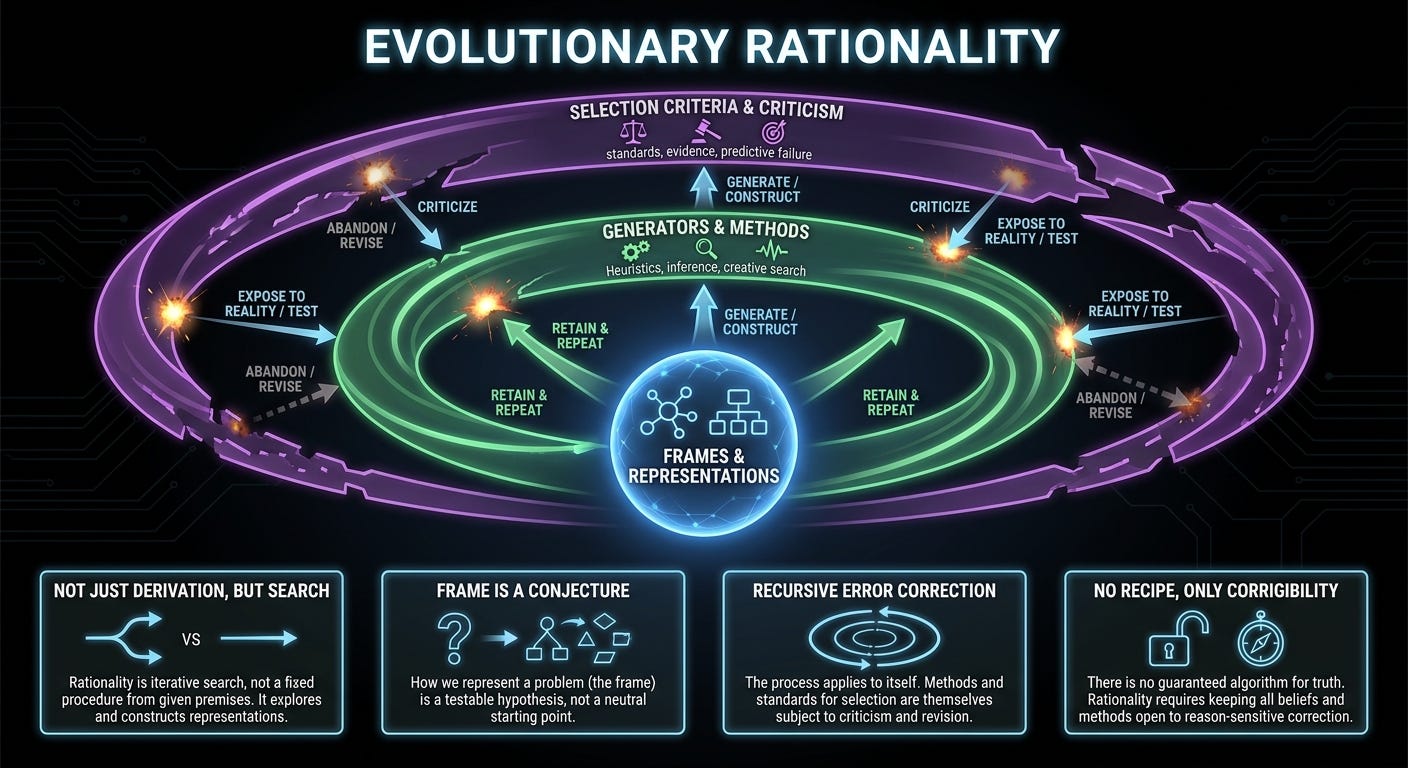
Rationality is often described as a procedure for getting from premises to conclusions. Given hypotheses, evidence and goals, we reason about what follows. Logic settles which conclusions are valid, Bayesian inference how evidence should move our confidence, decision theory how to choose among actions, and optimization how to search a specified space for better solutions. These are all forms of rationality, but they presuppose that somebody has already decided how the situation will be represented.
That prior work is framing. Which variables should exist? Where should the system boundary be drawn? What counts as evidence? Suppose a software team is told that its application is too slow. “Slow” might mean median latency, tail latency, throughput under load, or interface responsiveness, and the cause might sit in the database, the network, or the gap between what the product does and what users expect of it. The team cannot optimize until it has constructed some model of what is wrong.
The importance of framing becomes obvious when the first model fails. Perhaps the engineers halve server latency and users still complain. That result is evidence against the model itself, not only against a parameter inside it. Perceived responsiveness may turn out to be dominated by rendering behaviour rather than server latency. Rational inquiry therefore cannot be represented as a straight line from premises to conclusion. It is an iterative search over representations: construct a frame, reason within it, intervene or observe, encounter errors, and revise.
The Frame Is a Conjecture
A frame is a model of what kind of situation we are dealing with. It identifies relevant entities and distinctions, determines which relationships deserve attention, and establishes what will count as success or failure. Framing a production incident as a database bottleneck makes one set of measurements salient. Framing it as a user-interface problem makes another set salient. Neither frame is simply read off the raw facts.
This does not make framing arbitrary. A frame makes commitments about reality, and those commitments can fail. It can direct attention toward irrelevant variables, conceal causal structure that later matters, recommend interventions that do not work, or leave key observations unexplained. Frames can therefore be criticized in much the same way as other conjectures.
A narrow conception of rationality creates an unnecessary problem here. If rationality means applying formal procedures inside a fixed representation, then framing necessarily happens outside rationality. There is no general procedure that takes an arbitrary messy situation as input and computes its uniquely correct representation. But there is also no general procedure that takes nineteenth-century physics as input and returns general relativity, or that tells a programmer which abstraction will expose a hidden bug. The absence of such a procedure does not place theory construction or debugging outside rational inquiry.
The mistake is to identify rationality with derivation. A process can be rational even when its candidate representations are not mechanically derived, provided those representations remain exposed to disciplined error correction.
Rationality as Search
The evolutionary picture is not new. Popper described the growth of knowledge in evolutionary terms: conjectures generate variation, criticism eliminates error, and surviving theories remain provisional rather than final. Donald Campbell, who later coined the phrase “evolutionary epistemology”, had already carried the schema below explicit theory in 1960, calling it blind variation and selective retention and applying it to perception, learning and creative thought. Evolutionary rationality takes that structure and applies it to frames, heuristics, methods, and the machinery that generates and evaluates them.
Evolution provides a useful model because it does not inspect an environment and directly compute the optimal organism for it. It generates variation, exposes that variation to selection pressure, retains successful variants, and repeats. The process has a general search architecture without containing a recipe for the particular solution that will eventually survive.
Rational inquiry can have the same structure. We generate hypotheses, models and frames, and expose them to evidence, criticism, experiment and attempted intervention. Failures are modified or abandoned; survivors are kept provisionally and criticized further. Evolutionary rationality is the view that this recursive process of generation, selection, retention and revision is itself a form of rationality.
The analogy is structural rather than biological. Human inquiry is much more directed than natural selection. We can invent alternatives on purpose, borrow representations from other domains, and simulate consequences, so much of the selection happens in imagination and bad ideas die before anyone implements them.
There need be no deterministic procedure for generating the right hypothesis or frame. Variants can come from analogy, heuristic search, deliberate construction or accident: a dream, a typo, a chance conversation. The causal origin of an idea does not determine its epistemic status.
Human variation is also not blind in the biological sense. By the time a candidate explanation or frame reaches conscious attention, it has often survived several layers of prior selection. Experience shapes which patterns we notice, and education and culture hand down abstractions that earlier inquiry found worth keeping. Learned heuristics suppress enormous regions of an otherwise intractable search space. An expert therefore does not search the same distribution of possible frames as a novice; years of error correction have altered the generator itself.
What presents as intuition is often compressed selection history. The engineer who suspects lock contention on first hearing the symptoms is running a generator that earlier debugging has already trained.
Evolutionary rationality therefore operates on the machinery that produces and evaluates representations as well as on the representations. Inquiry changes which conjectures occur to us and which criticisms seem salient, so the generators and selectors of frames are themselves under selection. The search process is itself one of the things search revises.
Not every adaptive process is rational. A thermostat responds to error, but it has no alternative models to compare and no criteria for judging them that it could revise. Rationality requires reason-sensitive error correction over representations, not merely behavioural adaptation. A process is rational when it can treat evidence, contradiction, failed prediction, failed intervention, and criticism as reasons to revise its beliefs, models, or methods.
That criterion gives irrationality real content. A process is irrational when it systematically insulates a belief or method from relevant criticism, applies standards inconsistently to protect a preferred conclusion, ignores predictive failure, or continually redefines success so that nothing could count against the current frame.
Beyond Bayesian Updating
Bayesian inference, which I defended in its fallibilist form in The Probability Tribes, is the right tool once the relevant possibilities have been represented. Given hypotheses, priors, evidence, and a likelihood model, it tells us how our credences should change.
But Bayesian updating does not by itself decide which hypotheses should exist. It does not tell us which variables deserve representation, whether two apparently distinct hypotheses are really instances of a more general model, or whether the ontology underlying the whole calculation is defective. Those are problems of model construction and criticism, and as I argued in The Bias Before Bayes, correct inference carries forward whatever the model generator put in.
Fallibilist Bayesianism handles this by refusing to grant the probabilistic model unquestioned authority. If observations repeatedly resist the representation, we can revise the hypothesis space rather than endlessly redistribute probability inside it. Evolutionary rationality generalizes that idea. Bayesian updating is one error-correcting mechanism, available when the current representation is adequate; when the representation itself fails, the search moves to the level of models and frames.
Sometimes the appropriate response to evidence is to move probability mass between existing hypotheses. Sometimes it is to invent a hypothesis that did not previously exist. Sometimes we need to change the variables, redraw the causal graph, or replace the frame entirely.
Rationality All the Way Up
In Meta-Rationality Is Just Rationality All the Way Up, I argued against treating frame revision as a separate epistemic faculty. David Chapman is right about the phenomenon that motivates his concept of meta-rationality. Formal systems work only after reality has been rendered into sufficiently definite terms, and no mechanical procedure guarantees the correct rendering. Real situations are messy, ambiguous, and resistant to complete formalization.
The disagreement is partly terminological, but not wholly so. Chapman draws the boundary of rationality around systematic operations performed within sufficiently definite representations, and so treats the management of those representations as a different cognitive mode. Evolutionary rationality draws it elsewhere: a process counts as rational when its representations and methods stay open to the reason-sensitive correction described above. That criterion includes formal inference without being exhausted by it. Frames need no special exemption. They are conjectural representations like other models, and no additional epistemic tier is required because the object under criticism happens to be the frame within which earlier reasoning occurred.
The same recursion applies to criticism itself. A favoured statistical test can turn out to be unreliable under certain conditions, an experimental convention can introduce systematic bias, an explanatory virtue we prized can mislead us. The standards by which models are evaluated are corrigible too.
That does not entail relativism. Corrigibility does not require an ultimate, unrevisable standard sitting beneath all the others. Selection criteria can themselves be criticized because the world supplies constraints that are not under our control. We may revise what we count as evidence, how we measure an outcome, or which explanatory virtues we value, and with enough ingenuity any single failed prediction can be reclassified as measurement error. The reclassification buys time, not immunity. A team can redefine “slow” until its latency target is met, but redefining it does not stop users complaining, and every convention revised to rescue a frame has to survive the next intervention as well. Reality does not provide a final frame; it constrains which frames continue to work.
This need not generate an infinite hierarchy of rationality, meta-rationality, and meta-meta-rationality. The same evolutionary process can operate over objects at different levels.
Postscript
The architecture contains no recipe: generate alternatives, expose them to criticism and to reality, retain what survives, and repeat, with the generators and selectors revised along the way. Its simplicity is not ease. Search spaces can be enormous, selection criteria can conflict, and feedback can arrive late or ambiguous. A bad frame can protect itself by deciding which evidence counts as relevant, and institutions can reward representations that survive politically rather than epistemically.
Nothing in the architecture guarantees convergence on truth. It asks only that frames, and the standards used to judge them, stay exposed to the kind of failure that removes them.