

Metaphysics gets described as a strange kind of science. Physics gives us the structure of matter and spacetime, biology the organization of living systems, and metaphysics is supposed to deliver something deeper still: causation, identity, possibility, substance, persistence, existence. Missing from that picture is any equivalent of the experimental machinery that gives the sciences their error correction. An inquiry into mind-independent reality conducted through intuition and argument owes an account of why its methods should converge on anything.
Andrew Brenner’s The Methodology of Metaphysics takes that challenge as its organizing problem. Declining to assume metaphysics has one obvious purpose, Brenner distinguishes five candidate aims: uncovering deep non-conceptual truths, producing practical benefits, achieving understanding, discovering stable equilibria among possible views, and analyzing or engineering our concepts. Since a methodology can only be judged against what it is meant to achieve, the standard critique lands only if it targets the right aim.
The taxonomy is useful and partitions the problem wrongly. Four of the five aims are requirements, tests, or performance criteria inside a single activity. The fifth is that activity.
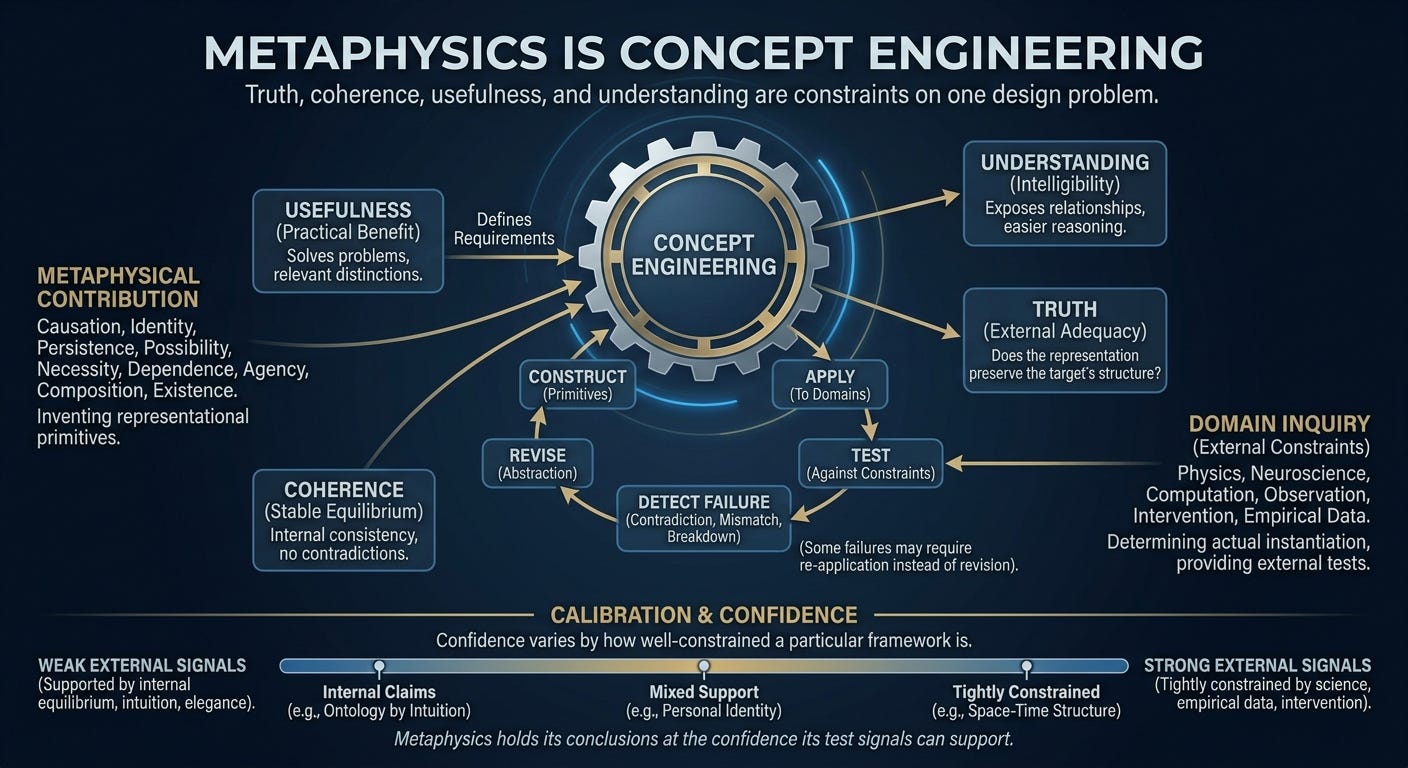
Metaphysics is concept engineering.
I have put a version of this before as concept creation, with the weight on invention: causality, substance, identity, and modality get built, not found. Engineering names the same activity with its constraints attached. That earlier statement took utility, clarity, coherence, and explanatory power to exhaust the criteria for a metaphysical system, which understates what an invention has to answer to once it is in use.
Engineering concepts
Metaphysics works on causation, identity, persistence, possibility, necessity, dependence, agency, composition, existence. These are representational primitives: the machinery through which questions get formulated, theories constructed, relations identified, and differences ranked as mattering or not mattering. They are not labels stuck onto structures already divided up for us.
That leaves metaphysics inventive without leaving it arbitrary, because engineering is invention under constraint.
A network protocol is invented, and its design answers to reliability, interoperability, latency, failure modes, and adversarial conditions. Testing belongs inside the design process. Implementation exposes edge cases, tests falsify assumptions, and failures force revision of the abstraction itself. The loop is iterative:
construct → apply → test → detect failure → revise
Concept engineering has the same shape. An account of personal identity may distinguish biological continuity, psychological continuity, informational continuity, embodiment, memory, and agency. Those distinctions then get stressed against split brains, dementia, gradual neural replacement, teleportation, uploading, and whatever cognitive science currently supports. Some prove too coarse to do the work asked of them. Others generate contradictions, or fail to preserve structures we care about. Revise, reapply, test again.
The concepts are engineered artifacts. The constraints on their successful application are not.
The distinctive role
Concept engineering happens everywhere, so showing that metaphysicians do it establishes very little. The stronger claim is that it identifies what metaphysics is for.
Metaphysical problems surface where existing representational primitives become inadequate. What makes something the same object through change? What is it for one thing to depend on another? What separates causal dependence from correlation? Under what conditions do many things constitute one thing? Each question concerns the categories through which more specific claims become expressible at all.
Once those primitives are specified well enough, determining what actually instantiates them usually becomes another discipline’s work. Physics tells us which spacetime structure obtains, neuroscience constrains accounts of personal continuity, and computer science investigates computational equivalence and the persistence of informational structure. The boundary stays porous, because a scientific result can reveal that a metaphysical distinction was badly drawn. Construction and revision of the conceptual machinery remains the metaphysical contribution.
A critic will point out that metaphysicians also build theories, reason modally, defend ontologies, and give structural explanations. They do, and each of those activities runs on the primitives. Modal reasoning needs a worked account of possibility, ontology needs one of existence, structural explanation needs one of dependence. Where such work stays metaphysical rather than passing to a special science, it is exposing consequences of the primitives or defects in them, and feeding the result back into their revision.
Metaphysics engineers and revises the categories through which the deeper structural questions become expressible. Domain inquiry supplies some of the constraints they answer to.
Four aims, one artifact
Brenner treats deep truth, practical benefit, understanding, and stable equilibrium as alternative purposes metaphysics might have. Read as questions asked about an engineered conceptual scheme, they stop competing.
Practical benefit concerns requirements. What problem is this scheme meant to solve, which distinctions matter for that purpose, and at what resolution?
Understanding concerns intelligibility. Does the framework expose the relevant relationships, implications, and alternatives, and does it make the target domain easier to reason about?
Stable equilibrium concerns internal integrity. Are the commitments mutually compatible, does solving one problem generate contradictions elsewhere, and does the framework need an expanding stock of ad hoc exceptions?
Deep truth concerns external adequacy. When theories built from the framework purport to describe reality, do those representations preserve the relevant structure of their target?
Concept engineering is the activity that integrates the requirements, runs the tests, and performs the revisions. It sits at a different level from the other four, which is why listing it as a fifth alternative obscures the relation.
This decomposition parallels the three-level account developed in The Three Levels of Truth. Pragmatism explains why accuracy matters and which distinctions are relevant. Correspondence specifies what successful representation consists in. Coherence, together with whatever observation and intervention a domain permits, tells us whether the representation is succeeding. Three jobs in one system, and the same separation clarifies metaphysics.
Purpose determines what must be preserved
Practical considerations legitimately shape metaphysics because every representation is selective. No useful map preserves every property of its territory; its purpose determines which structure must survive the projection.
A legal concept of personal identity has to preserve responsibility, continuity of obligation, and ownership. A neuroscientific account cares about continuity of cognitive organization. A theory adequate to cryonics or uploading has to separate biological continuity from informational and functional continuity. None of these requirements settles the metaphysics. Each settles what a usable framework must be capable of representing.
Brenner canvasses stronger pragmatic proposals, on which practical consequences determine which metaphysical beliefs we should hold, or even which metaphysical claims count as true: therapeutic arguments in the Epicurean and Buddhist traditions, pragmatic arguments for belief in free will, and emancipatory approaches in social metaphysics on which a theory’s political effects contribute to its success.
That goes too far. Utility fixes the requirements of a representation. It does not determine whether the representation satisfies them. A protocol designed for fault tolerance is judged partly by whether it survives failure, and the desirability of fault tolerance never made an unreliable protocol reliable. No pragmatic goal makes an inaccurate representation accurate by making belief in it useful.
Contested failure criteria
The engineering analogy would mislead if it implied that metaphysics enjoys the failure conditions of software or bridge design. Usually it does not.
In software there is broad agreement that dropping packets violates the specification. In metaphysics the disagreement often reaches the specification. One philosopher treats a counterexample as fatal where another accepts the consequence as a price worth paying. One counts intuitive plausibility as evidence where another counts the same intuition as cognitive noise. The dispute concerns which tests should apply, and only then whether the framework passed them.
Engineering is not immune. Safety, cost, performance, maintainability, compatibility, and fault tolerance conflict routinely, and there is no unique optimum until someone ranks the requirements. Metaphysics has it worse because some of its requirements are themselves conceptual and epistemic. The model survives this, with a correction: a large fraction of metaphysical disagreement is requirements engineering. Before asking whether a concept has failed, we often have to argue about what it was supposed to preserve. Once those requirements are set, some failures stop being matters of preference: contradiction, empirical mismatch, predictive breakdown.
Coherence is a test harness
Brenner’s treatment of equilibrism reaches the same structure from the other side. Equilibrists give up on identifying true metaphysical theories and propose mapping packages of claims that form stable equilibria: internally coherent, explanatorily satisfactory, compatible with what we otherwise take ourselves to know.
Coherence is indispensable and insufficient. Infinitely many internally consistent systems can be built. A fictional ontology can be elegant, systematic, and free of contradiction. Internal integrity establishes nothing about whether a system represents anything outside itself.
Brenner presses close to this objection. Narrow logical consistency is too cheap, and once equilibrists strengthen tenability with explanatory virtues, plausibility, and fit with existing knowledge, they have reimported the epistemic standards whose unreliability motivated the retreat from truth-seeking. From an engineering perspective there is no paradox. Coherence is an internal test suite: a system that fails it is defective, and a system that passes it has merely not yet exhibited one class of defect. Equilibrism identifies a necessary metaphysical activity and mistakes one evaluation criterion for the whole enterprise.
Understanding the model, understanding the target
Brenner also considers understanding as an aim, canvassing accounts on which philosophical progress consists in better representation of dependence relations, and McSweeney’s proposal that metaphysics expands our capacity to imaginatively inhabit a world in which some thesis holds.
These are different achievements. We can understand a model without believing it describes reality; a sufficiently detailed fictional world has clear laws, dependencies, identities, and modal structure, and understanding it means grasping its internal organization and consequences. Understanding the target requires external adequacy. A framework improves our grip on actual causation or persistence only insofar as it captures structure in the world.
Brenner sees the danger and states it well: metaphysics aimed only at imaginative inhabitation starts to look like unusually rigorous speculative fiction, which is worth having and is not knowledge of reality. Concept engineering requires both kinds of understanding. We have to understand the artifact well enough to reason with it, then test whether reasoning with it improves our grip on what it was built to represent.
Invention is compatible with joints
A realist will object that this understates discovery. Perhaps reality has objective structure, natural properties, genuine dependence relations, privileged joints that some schemes carve better than others, and metaphysics finds what was there all along.
Concept engineering requires denying none of that. The claim concerns the status of the representation, not the absence of a represented structure. Reality may contain stable mind-independent structure that strongly favors certain schemes, and the concepts through which we describe that structure are still constructed. We invent coordinate systems without inventing geometry, notation without inventing the relations it encodes, measurement schemes without inventing the regularities measured. If there are joints, a successful metaphysical concept may track them unusually well, and tracking them is a decisive reason to retain and refine it. The concept was not sitting in reality waiting to be found.
Concepts are tools. A tool that preserves the wrong structure fails as a tool.
Truth constrains the invention
Does truth then become somebody else’s department? No, because testing an invention is part of engineering it.
Take causation. Philosophers and scientists have built regularity accounts, counterfactual dependence, interventionist models, mechanisms, and structural causal models. Each contains engineered distinctions, comparable for clarity, expressive power, coherence, and computational tractability. Each can also be applied to actual systems and judged by whether it supports successful explanation, prediction, intervention, and integration with established knowledge. Failure there exposes conceptual defects: a framework that keeps collapsing distinctions which repeatedly matter under intervention needs revision at the level of the concept. Discovery and invention run in the same loop.
None of this collapses metaphysics into experimental science. It makes metaphysics and empirical inquiry coupled components of one error-correcting architecture. Brenner documents how much traffic already crosses it, cataloguing metaphysicians who draw on relativity, quantum mechanics, neuroscience, evolutionary theory, split-brain research, and cosmology, against critics who treat scientific naivety as the field’s defining condition. Other constraints are logical, conceptual, or comparative. Science adjudicates only some metaphysical questions. No framework earns confidence by being internally attractive.
Calibration
The hard case arrives where external testing is weak.
Metaphysical frameworks always generate internal error signals: contradiction, redundancy, explanatory failure, runaway complexity, conflict among commitments, inability to handle central cases. A theory that fails internally needs revision whether or not any experiment could touch it. But internal correction is endogenous to the system under examination. A framework can be coherent because its assumptions support one another while all of them misrepresent the target.
External error signals are stronger because they vary independently of the framework. Observation, intervention, prediction, measurement, replication, and constraints imported from successful neighboring theories force a conceptual system to answer to something beyond its own standards.
Brenner’s central defense of non-empirical theoretical virtues turns on an arbitrariness argument: if simplicity is truth-conducive in science, no principled difference makes it non-truth-conducive in metaphysics, so denying the transfer is unmotivated. The argument works, and it transfers less than it appears to. In science, simplicity adjudicates among hypotheses that have already survived empirical filtering; it breaks ties and excludes pathological alternatives inside a space that observation has pruned. In metaphysics it does the pruning itself. Same virtue, different load. Establishing that simplicity is truth-conducive in both domains leaves entirely open how much weight it can bear when nothing else is bearing any, and Brenner’s arbitrariness argument is silent on that question, which concerns the epistemic environment and not the virtue.
Which suggests a calibration principle. Confidence in a metaphysical claim should scale with the strength and independence of the error signals capable of revising it.
A framework tightly constrained by physics, neuroscience, computation, or intervention deserves more confidence than one supported mainly by elegance, intuition, and internal equilibrium. The second kind is still worth constructing, and its conclusions stay conditional.
Postscript
Brenner treats conceptual analysis and engineering as legitimate metaphysical activities while doubting they should displace the ambition to uncover deep non-conceptual truths. That opposition depends on reading concept engineering thinly, as adjusting definitions for convenience, in which case it is indeed a retreat. Read thickly, as constructing representational primitives, applying them to hard domains, testing them against logical and empirical constraints, diagnosing failures, and revising accordingly, truth-seeking is already inside the process. Metaphysics needs no special faculty for perceiving ontology. It contributes to truth-seeking by building the machinery through which difficult claims about reality become formulable and testable.
The calibration principle then limits the discipline it defends. Primitives are the part of a conceptual scheme that external tests reach last, which means the most distinctively metaphysical work is the work with the weakest independent error correction. Metaphysics earns its place by building the categories, and pays for it by holding its conclusions at the confidence its test signals can support, which for large stretches of the field is not much.