

Conditionalism began as a claim about truth, but morality is where the doctrine has to prove itself.
It is easy to see why factual claims need conditions. “The electron has charge -1” is not a sentence floating free of theory, measurement, and definition. It is true inside a framework where “electron,” “charge,” and measurement have stable meanings. Change the framework far enough and the claim has to be translated, refined, or abandoned. Truth requires conditions under which its terms become determinate.
That was the original target of Axionic Conditionalism. Only conditionals can be true or false, because every assertion hides an antecedent: given this frame, these definitions, these observations, this claim follows. Remove the frame and the claim loses its grip.
The rule applies to itself. “Only conditionals can be true” makes no claim from outside all frames; it says what truth requires once we are in the business of making propositions intelligible, testable, and answerable to conditions. Ask for the truth of Conditionalism outside all conditions of meaning and inference, and the request has already dismantled the setting in which “true” and “false” do any work. Conditionalism does not exempt itself. It is the rule stated from inside the only place rules can be stated, a condition-bound practice of thought.
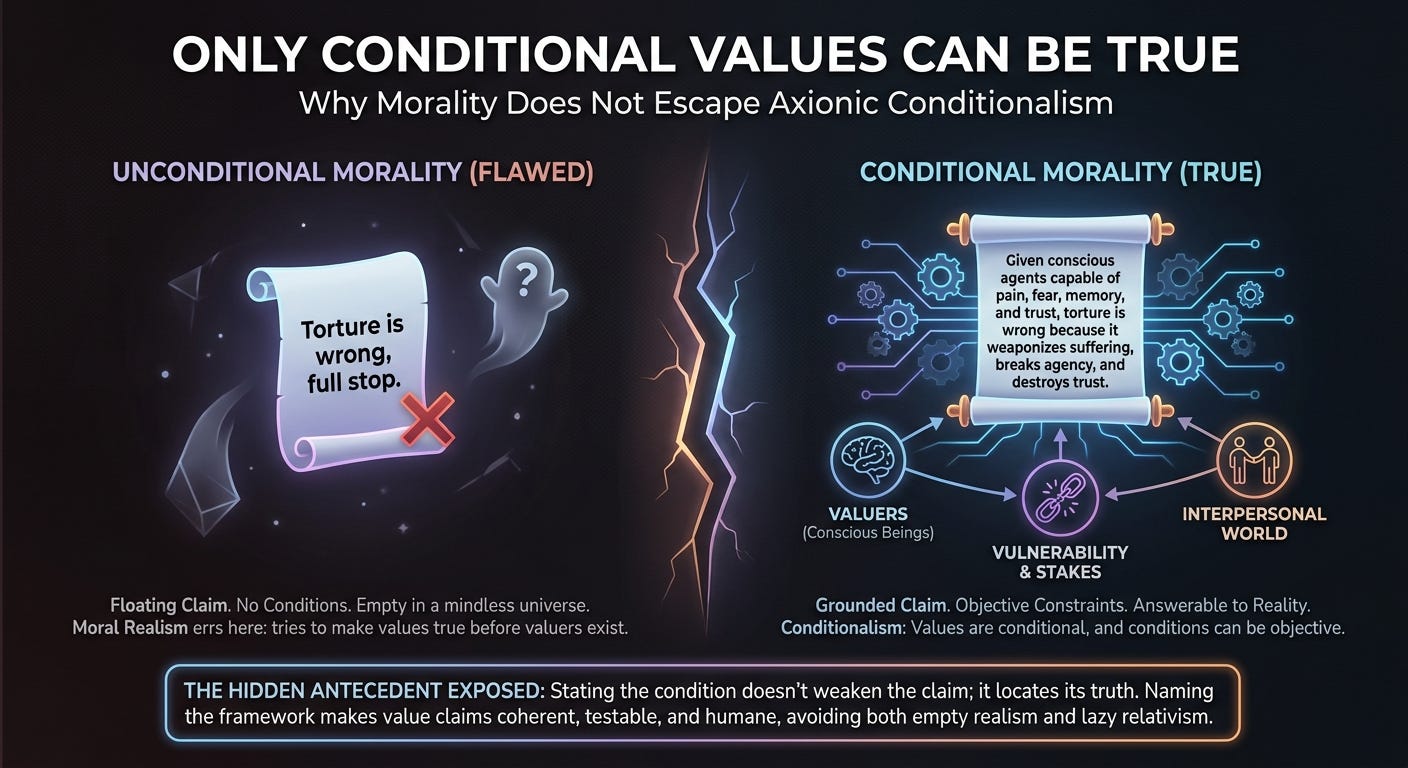
Values seem to resist this. “Torture is wrong” does not read like “water boils at 100°C at one atmosphere.” It reads as a demand, not a measurement, and morality is exactly where we want the condition to vanish. We do not want to say torture is wrong if certain assumptions are granted. We want to say torture is wrong, full stop.
The unconditional form is misleading. Value claims also require conditions: the conditions under which anything can matter at all. A value claim becomes true or false only inside a world that contains valuers, and a moral value claim only inside a world of interacting beings for whom suffering, agency, trust, and coercion can make a difference. Strip those beings away and the claim has nowhere to land. No valuer, no value; no conditions, no truth.
The hidden antecedent
Every value claim carries a hidden antecedent. For a factual claim it runs:
Given these definitions, observations, inference rules, and domain conditions, claim C follows.
For a value claim it runs differently:
Given valuers of kind V, with capacities C, vulnerabilities U, interests I, and ends E, state X is better or worse than Y.
Naming that antecedent is not a retreat into subjectivism. It specifies what the value depends on, and the dependence can be perfectly objective. A bridge is good or bad only relative to load, material, and use, which does not make engineering arbitrary: once the conditions are fixed, the bridge carries the weight or it falls. A chess move is good or bad only relative to the rules and the goal, which does not make every move equal: once the game exists, a blunder is a real blunder. Medicine is good or bad only relative to organisms whose functioning matters, which does not turn sepsis into a lifestyle preference.
Values run the same way. They do not have to float free of conditions in order to be real; they need the right conditions — valuers, stakes, vulnerability, and a world where actions have consequences for beings who can be affected. Moral realism errs by trying to make values true before there are any valuers. Relativism errs by assuming that because values need valuers, anything goes. Conditionalism rejects both: values are conditional, and conditions can be objective. Once they are in place, value claims can be coherent or incoherent, humane or monstrous.
The view has relatives. Hume exposed the gap between description and prescription. Philippa Foot read much of morality as hypothetical rather than categorical. Aristotelian naturalists ground evaluation in the needs of the life-form. Constructivists derive normativity from the conditions of agency. Conditionalism sits in that neighborhood with a wider claim: truth, meaning, agency, and value all become determinate only under conditions.
Torture as a test case
Take the flat claim:
Torture is wrong.
It sounds unconditional, but its force depends on a dense background of facts about the beings involved. A Conditionalist expansion makes the background explicit:
Given conscious agents capable of pain, fear, memory, and trust, torture is wrong because it turns suffering into an instrument, overrides the victim’s agency, corrupts the torturer, and poisons the trust on which social beings depend.
That expansion does not weaken the claim. It explains why the claim has force. Torture is not wrong because the word “wrong” names a ghostly property stuck to the act; it is wrong because of what torture does inside the conditions that make morality possible. It weaponizes suffering, breaks agency, and turns a person into a tool, and it trains the torturer to treat another mind as material. Those are not arbitrary reactions. They are facts about conscious, social, vulnerable agents, and any moral system built for such beings has to reckon with them.
Now remove the conditions. Imagine a universe with no conscious beings at all: no pain, no fear, no one to torture and no one tortured. There, “torture is wrong” is not false. It is empty. The claim has lost the conditions under which it could be evaluated either way. That is the moral form of Conditionalism — a value claim needs a world in which value can arise.
Conflicting valuers
Conditionalism does not hand every valuer a certificate of correctness inside his own head. A predator can hold coherent predatory values; a sadist can prize suffering; a tyrant can prize domination. If the only question is whether some act serves that agent’s private end, the answer is often yes.
Private optimization is not yet morality. Morality arises where agents with their own purposes, vulnerable to one another, have to share a world, so its conditions are interpersonal from the start. Under those conditions, predatory value systems fail for reasons that are not arbitrary. They cannot be generalized across agents without licensing predation in return; they destroy trust, convert cooperation into domination, and make everyone’s security hang on power rather than on any claim. A psychopath’s values may be intelligible as the values of a psychopath. They are defective as morality for social agents.
The same holds for cultures built on domination. A militaristic society can produce discipline, cohesion, and courage, which are real goods under some conditions. But if it secures them by crushing agency, sanctifying cruelty, and treating persons as state material, it is defective for the full range of beings humans actually are. Conditionalism can weigh those tradeoffs without claiming a commandment from outside the universe. The question is never “what does this tribe happen to value?” It is what follows once value claims have to be shareable, criticizable, and action-guiding among beings who can affect each other. Domination does not become moral merely because a dominator values it.
What Harris saw
Sam Harris’s The Moral Landscape gets part of this right. Harris argues that morality concerns the well-being of conscious creatures, and that since those creatures can suffer or flourish, and the causes of suffering and flourishing belong to the natural world, science can say something objective about morality.
He is right that morality has no subject matter without conscious experience. A world of rocks holds no cruelty, no kindness, no despair. Consciousness supplies the stakes, and once there are beings who can suffer, trust, plan, and be broken, the world contains morally relevant facts. He is also right against lazy relativism: a society built on terror is worse for human beings than one built on law, literacy, and free inquiry, and that is not a matter of taste but a fact about the kinds of beings we are.
His error is treating the well-being axis as unconditional. The defensible claim is this:
Given that morality concerns the well-being of conscious creatures, many moral questions have objective answers.
The overclaim is this:
Morality is objectively and unconditionally about the well-being of conscious creatures.
Conditionalism takes the first and blocks the second. Harris has mapped real terrain after fixing the axis; he has not shown the axis is forced on every possible rational mind. He skips the interpersonal conditions under which moral authority has to be earned and treats the well-being axis as though reason alone fixed it. The landscape is real. The direction of ascent comes from valuers.
The axiom problem
Harris defends the well-being axis by comparing it to the assumptions behind science and mathematics. Every inquiry needs starting points: logic assumes non-contradiction, science assumes evidence and regularity, mathematics assumes axioms. Why should morality be embarrassed by the axiom that conscious well-being matters?
Because the assumptions do different jobs. Logical and evidential norms are constitutive of reasoning itself. Allow contradiction without constraint and inference collapses; sever belief from evidence and empirical inquiry collapses. A mind that rejects these has not chosen a rival science; it has stopped reasoning. The well-being axiom has a narrower status. It is constitutive of humane morality, not of rationality as such.
Picture a flawless reasoner that understands suffering perfectly and is unmoved by it. It predicts pain, models fear, follows every consequence, and never contradicts itself, and it simply does not hold conscious well-being as a terminal value. Such a mind may be monstrous. It has made no logical error. Ordinary cases show the same gap: a sadist understands suffering and prizes it, a martyr understands it and accepts it as the price of salvation. These people may be corrupt or deluded or dangerous, but their error is not the error of affirming a contradiction.
So the analogy fails at the join. The well-being axiom has the status of health in medicine, not of logic in reasoning. Medicine becomes objective once health is valued, and it cannot prove that every mind must value health. Harrisian morality becomes objective once conscious well-being is valued, and it cannot prove that every mind must take conscious well-being as its governing concern. None of which makes the axiom trivial. Health matters enormously to anything that cares about living; well-being matters enormously to anything that can suffer and flourish. The importance is real, and it lives inside the conditions that make importance possible.
Conditional does not mean subjective
A bad inference waits right here: if values need valuers, then values are merely subjective.
Subjective whim is unconstrained preference. Conditional value is constrained by the structure of the valuer and the world, and the world pushes back. Call a bridge beautiful and the load test can still humiliate you. Call terror and humiliation good for human flourishing, and psychology, history, and ordinary experience answer back. A claim can be conditional and still answerable to reality.
Human beings are a particular kind of valuer: conscious, vulnerable, social, embodied, carrying memory and forming attachments. We can be damaged, coerced, educated, or stunted. These facts do not dictate every detail of morality, but they fix the space of moral sanity. A system that ignores suffering, treats agency as disposable, and rewards predation is not merely different from ours. It is defective for beings like us, because it misreads the conditions of its own application. The objectivity arrives once the conditions are admitted: once a being can suffer, facts about suffering matter; once it depends on trust, facts about betrayal matter; once it can learn, facts about truth and error matter. Conditionalism does not erase value. It locates it.
The wider pattern
The same structure runs across the Axio framework. Truth requires conditions of meaning, observation, and inference. Meaning requires contrast, use, and context. Agency requires choice, consequence, and self-maintenance. Value requires valuation, vulnerability, and stake. Morality adds reciprocal vulnerability and the live possibility of harm.
There is no view from nowhere in any of them, only perspectives disciplined by conditions. Demand unconditional truth and you get metaphysics. Deny it altogether and you get nihilism. Conditionalism refuses both. And a claim does not weaken when its conditions are named. It gets clearer. The hidden antecedent was always there, and stating it turns a slogan into a proposition.
Postscript
Conditionalism makes morality honest, not soft. It says torture is wrong under the conditions that make torture possible: conscious suffering, violated agency, domination, fear, and broken trust. It says freedom is valuable under the conditions that make agency possible, and truth matters under the conditions that make learning possible. None of these has to be carved into the universe before any mind exists. Each becomes real where its conditions exist, and each can be argued, refined, and tested, because the conditions themselves are not arbitrary.
A mindless universe contains no values. A universe with valuing beings contains value wherever things can matter to them. A universe with social, vulnerable, conscious agents contains morality wherever an action can help, harm, liberate, or destroy. Only conditionals can be true, and that includes values.
Morality does not float free of all conditions. Nothing does. The conditions that anchor it are real, and for beings like us they are solid enough to bear the full weight of judgment.