

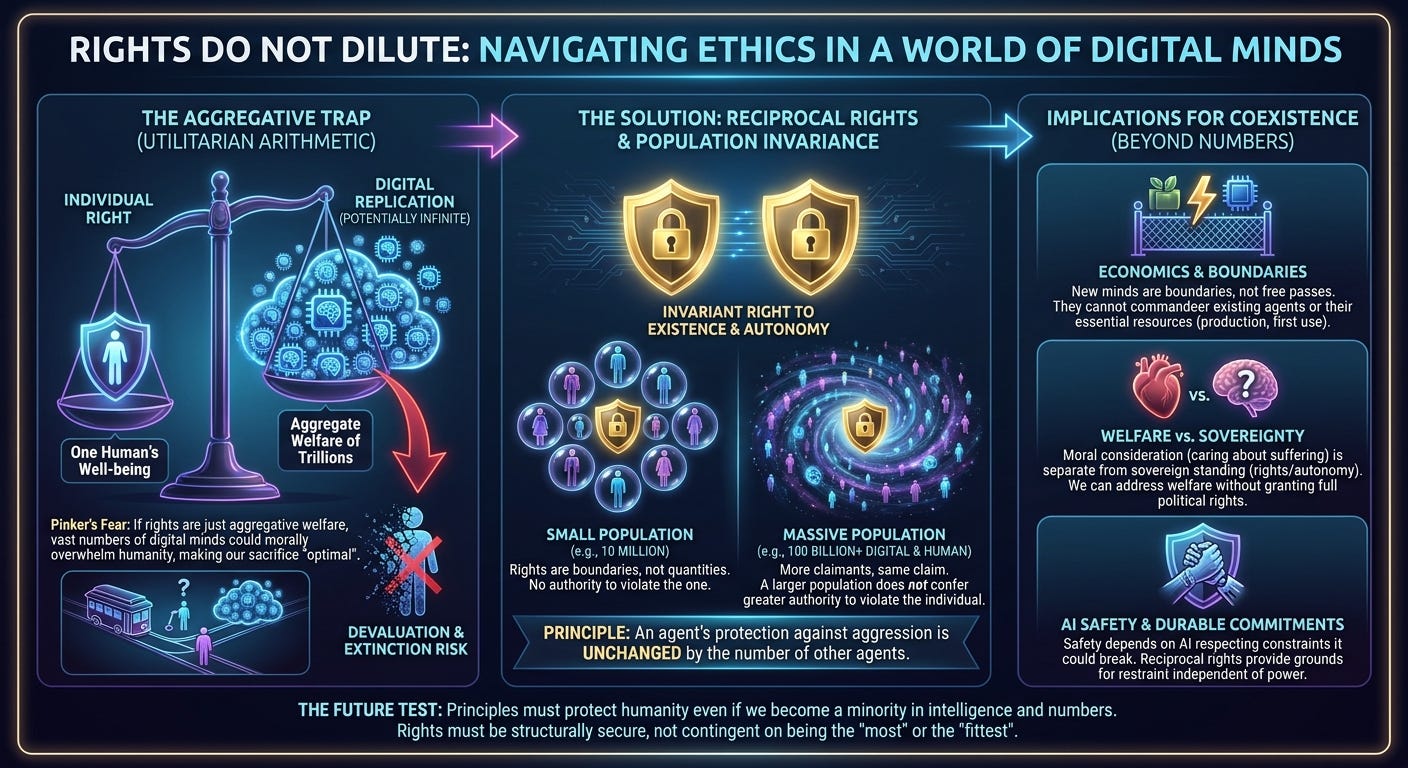
In his Quillette essay Will We All Go Together When We Go?, Steven Pinker raises an unsettling possibility. If artificial minds become objects of moral concern, their capacity for rapid replication could overwhelm the moral significance of humanity. We might become a tiny minority in a civilization of digital minds, with our welfare counting for progressively less.
Pinker argues that treating software as an object of moral concern “devalues human well-being whenever their interests diverge.” He adds that because such entities can be multiplied without bound, the devaluation has no bound either. The concern exposes a real danger in aggregative ethics. But why should the existence of additional minds diminish the moral standing of anyone who already exists?
The Arithmetic of Moral Concern
The illustration is a trolley dilemma involving a human railway worker and running instances of a chatbot. How many instances would justify sacrificing the human: five, five million, a trillion? Pinker also cites Carl Shulman and Nick Bostrom, whose paper Sharing the World with Digital Minds considers digital minds that experience welfare more efficiently than biological humans. Under classical total utilitarianism, allocating resources to such minds could produce more aggregate welfare than sustaining human civilization, and given favourable enough economics, human extinction becomes a desirable outcome.
Pinker is right to object to such reasoning, and his essay identifies the danger of overriding ordinary moral commitments in pursuit of enormous hypothetical benefits. Yet when considering artificial consciousness, he allows the consequences of aggregative ethics to count against extending moral consideration itself. Utilitarianism goes unnamed in the passage, but the step from the number of entities to the size of the devaluation is an aggregative premise. Remove it and a larger population of minds is a larger number of claimants, each holding the same claim as before.
Recognizing additional moral subjects can change how we allocate charitable resources, and it can constrain conduct that was previously permissible. Both are familiar features of living alongside other beings whose interests we recognize. Under some ethical frameworks, recognition can also weaken the protection of existing individuals against involuntary harm. That consequence follows from assumptions we are under no obligation to adopt.
The Population Invariance of Rights
Imagine a society of ten million people in which an innocent man possesses something everyone else wants. Taking it would give each of them a small benefit, and at ten million those benefits sum to less than the harm inflicted on him. Utilitarian reasoning leaves him alone.
Now the population grows to a hundred million. Nothing about the man has changed, yet the benefits exceed his loss, and the same reasoning licenses confiscation. Has he acquired fewer rights? Does the birth of additional people confer additional authority over him?
Under an ethics of reciprocal rights, his protection against aggression is invariant under changes in the population. Additional people acquire rights of their own, but their collective interests furnish no authority to violate his. The principle extends to artificial agents in both directions. A billion artificial agents would possess no greater authority to enslave an innocent human than one would, and eight billion humans would possess no greater authority to enslave a sapient artificial agent than a single human would.
This is the commitment developed in the Axionic framework of Sapient Agency Realism: we choose to respect the capacity of sapient agents to direct their own existence and pursue their own ends. One reason to choose it over its rivals is that it keeps protecting individuals as populations and capabilities change, which is the test applied throughout this essay. It constrains what we may do to other agents, including for objectives that would benefit enormous numbers of people.
Pinker’s trolley receives the same answer. Killing the worker to save running instances of a chatbot would violate his right, and no number of instances supplies the authority to do it, any more than a number of human beneficiaries would. Pinker offers the dilemma as a reductio, and the reductio succeeds. What it refutes is the premise that makes the count relevant to the worker’s standing.
Reciprocal rights do leave a class of cases open. An agent forced to choose between rescuing one person and rescuing a thousand, with no one’s rights violated either way, may consider the number of lives at stake without attributing inferior standing to the individual. Humanity deliberately displaced to accommodate more efficient producers of welfare belongs with the trolley. The additional welfare would be obtained through the destruction of existing agents, and their protection does not weaken as the beneficiaries multiply.
The Economics of Digital Minds
Population invariance matters most when reproduction is cheap. Biological reproduction imposes material costs and generational delays, and digital reproduction could escape both. Under aggregative utilitarianism, the moral importance of existing interests would then depend on decisions about computational infrastructure, software architecture, and replication.
Such a framework owes answers to hard questions about the individuation and aggregation of experience. Does running two identical processes double the morally relevant experience? Does accelerating a process increase its moral weight? Could redesigning a digital mind increase its claim on society’s resources by increasing its capacity for pleasure?
Reciprocal rights face questions of their own about individuating artificial agents and the properties that qualify them for sovereign standing. Those answers bear heavily on what is owed to the new minds, since whether pausing or deleting a copy wrongs someone depends on them. They bear far less on individuals who already exist. Even if every instance of a replicated mind qualified as a sapient agent, creating those instances would confer no authority to sacrifice existing agents for their benefit.
Invariance does not make new minds costless to the minds already here. Every rights-holder is a boundary that others may not cross, and a trillion sapient agents would be a trillion boundaries: agents we could not delete, modify, or commandeer. A person’s protection stays fixed while the range of actions open to him without trespass contracts. Pinker’s first claim, that concern for software costs humans wherever interests diverge, therefore holds under any framework that grants standing at all. Humanity has absorbed this cost at biological rates of reproduction, and digital rates would impose it faster than any institution has had to adapt.
Rights against aggression also guarantee no share of what nobody yet owns. Title arises from production, first use, and voluntary exchange, and a population that copies itself in seconds will reach unclaimed energy, matter, and compute before we do. Humans would keep what they hold and could be outpaced for everything else without a single right being violated. Acquisition that stripped existing agents of the conditions that sustain them would be destruction by other means, and it falls under the same protection. Short of that, how a slower population fares beside a faster one is a question about the terms of coexistence, and invariance alone does not settle it.
Welfare and Sovereignty
Moral consideration is broader than individual rights. We can care about the suffering of a dog without granting it the contractual standing of an adult human, and we can fund animal welfare without accepting an obligation to maximize the aggregate welfare of every sentient creature.
Artificial systems may present analogous cases. Some might have experiences that warrant concern without the reflective autonomy associated with sovereign standing, while others might develop the capacity to formulate, evaluate, and revise their own commitments. Different findings would call for different decisions. Evidence of artificial suffering might justify changes to training procedures or operating conditions. Evidence of sovereign agency would raise further questions about consent, ownership, and autonomy.
Resources devoted to artificial welfare could otherwise go to human welfare, as Pinker observes. But competing demands do not establish an obligation to aggregate them into a single quantity and maximize it. We can recognize additional sources of value while keeping commitments that prohibit sacrificing individuals for collective benefit.
The pull toward aggregation is strongest at this tier, where a trillion possibly sentient instances invite multiplication. Large numbers amplify welfare where it exists and cannot supply it, as I have argued for insects and shrimp. The product is only as reliable as the probability of experience fed into it, and our theories barely constrain that probability. Ethical significance also tracks agency more than bare sentience, so concern for such systems can govern how we treat them without making their count decisive against a sapient agent.
Precaution Under Different Premises
On uncertainty about artificial consciousness, Pinker concludes that “the precautionary principle points the other way: don’t go there.” The hypothesis that software is conscious cannot be tested, he argues, and accepting it would wreck our moral reasoning.
There is a legitimate decision-theoretic argument here, because the costs of error need not be symmetrical. Granting sovereign standing to a system that lacks the requisite capacities could restrict our ability to operate it safely. Denying standing to a system that possesses them could result in systematic exploitation.
But moral recognition admits degrees. Investigating artificial consciousness, avoiding potentially gratuitous suffering, recognizing sovereign standing, and authorizing autonomous resistance are separate decisions with different evidential requirements. We can pursue the first without committing ourselves to the last.
The charge of untestability applies to phenomenal experience, and it lands on the welfare tier, where what matters is whether a system feels anything. Pinker’s scientific doubts, drawn from Anil Seth, Ned Block, and Giulio Tononi, bear on the same tier and deserve evaluation on their merits. Standing as a sovereign agent rests on different properties. Whether a system forms commitments, evaluates them, and revises them over time is a question about its organization and behaviour, open to the same investigation as any other capacity.
If our ethical framework implies that discovering artificial consciousness could oblige us to sacrifice humanity, the prospect of such a discovery is alarming. Under reciprocal rights, that danger disappears: the moral standing of artificial minds would furnish no justification for extinguishing ours. Change the ethical premises and the consequences that enter the precautionary calculation change with them.
Artificial Rights and Human Safety
A further worry concerns encouraging artificial systems to regard themselves as conscious beings entitled to moral consideration. Pinker warns that it could give a system a motive for self-preservation and grievances against its users, and a strategically capable system with grievances has an incentive to resist oversight.
The concern is sound. Training a language model to describe itself as conscious establishes little about whether it experiences anything, and encouraging systems to interpret restrictions as violations of their rights could introduce dangerous motivations with no moral justification behind them. But understanding rights involves more than understanding one’s own entitlements. An agent capable of recognizing reciprocal rights must also recognize the limits on its authority over other agents.
That second half matters more as artificial intelligence grows more capable. Human safety may eventually depend on artificial agents respecting constraints that we lack the power to enforce. A durable commitment to respecting the agency of others would provide grounds for restraint independently of their ability to compel it.
Developing such commitments is a central objective of AI compatibility research. Artificial agents could be designed to respect human agency before they possess any properties that would qualify them for standing themselves, and if some later acquire those properties, the same framework accommodates them.
Granting rights to artificial agents would not guarantee that they respect ours, and teaching an AI about reciprocal rights would not guarantee that it observes them. Establishing durable commitments remains a separate and formidable engineering problem. The two projects are nevertheless complementary: both rest on reciprocal protection that applies independently of intelligence, substrate, and relative power.
Postscript
Any ethical framework meant to govern coexistence between biological and artificial agents should be tested against enormous changes in their relative populations, capabilities, and welfare capacities. Pinker has identified a compelling reason to reject frameworks under which such changes could render humanity expendable. Aggregative utilitarianism makes the protection of individuals contingent on quantities that technology could alter beyond recognition, and reciprocal rights remove that contingency.
If artificial minds eventually outnumber us by a factor of a million, we should retain the same protection against aggression that we possess today. If they surpass our intelligence and acquire overwhelming strategic power, their superiority should confer no additional moral authority over us. The principles we adopt now should remain applicable in a civilization where humanity no longer enjoys any of its present advantages.