

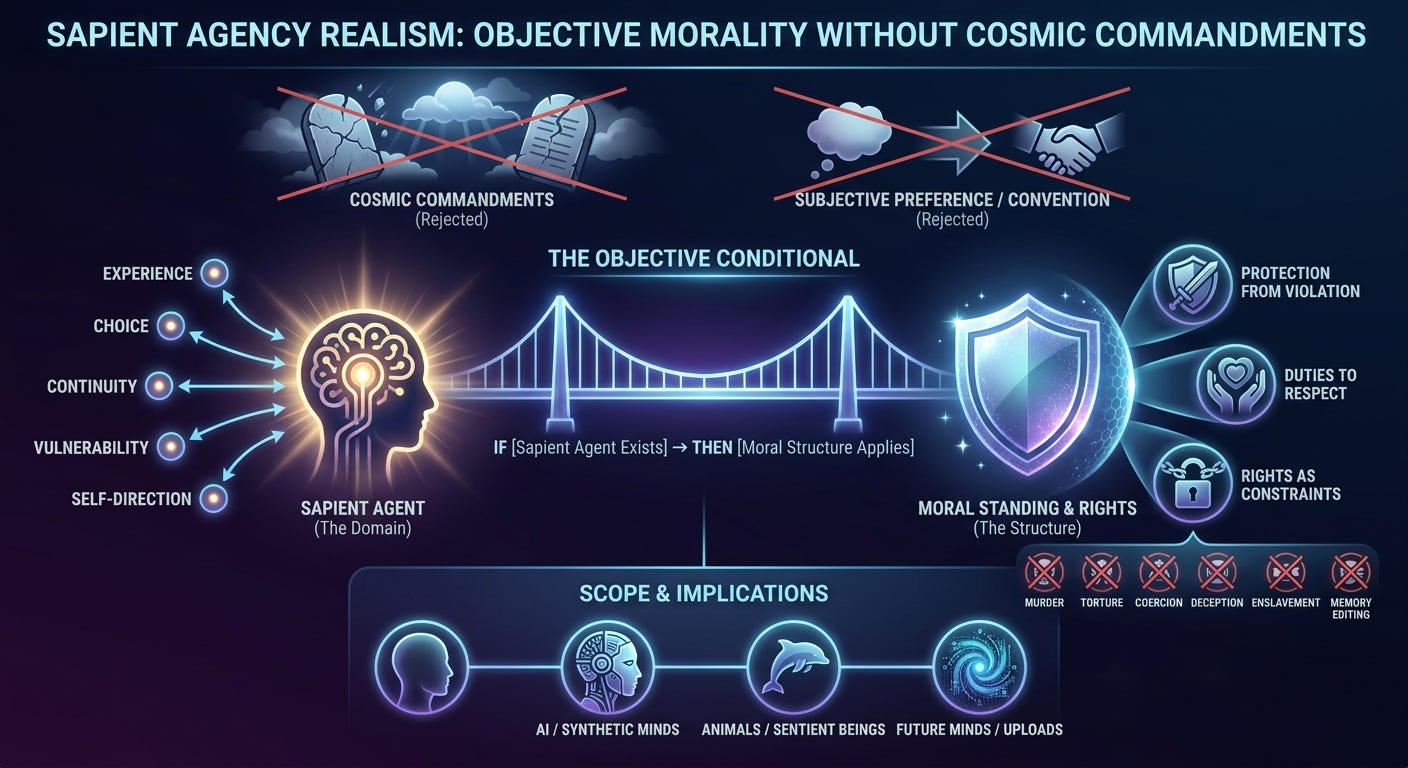
Most arguments about moral realism get trapped between two bad pictures.
On one side sits the old metaphysical picture: moral truth as commandment, inscription, Platonic object, or divine legislation. On this view, wrongness exists somewhere outside the world of minds and agents, waiting to be discovered like a distant planet or obeyed like a royal decree. Many people rightly recoil from that picture. It turns morality into metaphysical authoritarianism.
On the other side sits the anti-realist picture: morality as preference, emotion, convention, or disguised power. On this view, moral language may be useful, expressive, or politically necessary, but it does not describe anything objectively true. “Wrong” means “I dislike this,” “we punish this,” or “this arrangement destabilizes cooperation.”
Both pictures compress the problem too aggressively. Moral truth need not be unconditional to be objective. Many objective truths are conditional. If you want a bridge to stand, the load paths matter. If you want a theorem to hold, the inference rules matter. The antecedent does not make the consequent subjective. It specifies the domain in which the truth applies.
Moral truths have the same form. They are objective conditionals over the structure of sapient agency.
Once sapient agents exist, certain facts become morally relevant. These agents experience, interpret, choose, remember, anticipate, project themselves through time, and act under reasons. They can be helped, deceived, coerced, enslaved, or killed. Those are not merely events in neutral matter. They are events that bear on centers of experience and self-direction.
Sapient Agency Realism begins there. Moral structure appears wherever continuing sapient agency appears.
Objective Conditionals
A conditional truth can be perfectly objective.
If a structure is meant to bear weight, then tensile strength matters. If a proof is meant to preserve truth, then contradiction matters. If a map is meant to guide action, then accuracy matters. These claims are not opinions. They are conditional, but once the relevant domain is specified, their truth is independent of anyone’s preference.
The mistake in many arguments about morality is the assumption that objectivity requires unconditionality. That assumption is false, and Only Conditional Values Can Be True makes the extended case. Conditional truths govern engineering, mathematics, medicine, and ordinary practical reason. A surgeon’s claim that a severed artery must be repaired is conditional on the patient’s continued life, but it is not a subjective preference once that condition is in force.
Morality operates inside the domain created by sapient agents. Given beings that experience, reason, value, and project themselves through time, some actions objectively preserve or damage the conditions of their agency. Coercion replaces an agent’s structure of choice with another agent’s will. Deception corrupts the agent’s model of the world. Torture attacks agency through experience. Enslavement converts a center of choice into an instrument. Murder destroys the agent’s future.
These are structural descriptions before they are moral conclusions. Sapient Agency Realism says the moral conclusions follow because sapient agency is the domain within which value, harm, reason, and obligation become possible.
Morality does not need to be written into the universe before minds exist. A universe with no minds contains no suffering, no betrayal, no consent, no domination, no flourishing. It may still contain abstract conditionals, just as a lifeless universe may contain mathematical structure. But the moral domain becomes actual only when agents capable of mattering-to-themselves exist.
Sapience, Not Species
Humans have moral standing because they are sapient agents, not because they are human.
The distinction is not decorative. Species morality worked as a rough local proxy while humans were the only obvious sapient agents on the scene. It fails as a theory. If aliens, uploads, artificial minds, or uplifted animals possess the relevant form of agency, they enter the moral domain. Refusing them standing because they are not human would repeat the old error of confusing the local carrier with the general property.
Sapience should not be defined by human mimicry. A nonhuman agent need not have mammalian emotion, human language, or primate social instincts to matter morally. The relevant features form a cluster: experience, self-modeling, memory, preference, choice under reasons, and continuity across time. Nor does sapience here mean raw intelligence. A system that plans, optimizes, or solves problems without experience, valuation, or a continuing point of view may be powerful, but power is not standing.
Some beings will satisfy this cluster more fully than others. Moral standing may vary by degree, kind, or domain. A mouse, a child, a dolphin, an upload, and a mature artificial agent may not have identical claims. But the axis is agency, not species membership. The question is whether there is a subject, valuer, interpreter, and continuing center.
This matters because future moral catastrophes will likely arise from substrate chauvinism. Biological humans will be tempted to deny standing to artificial minds because they were built. Artificial minds may be tempted to deny standing to humans because we are slow, evolved, and fragile. Both moves are parochial. Origin does not decide standing. Substrate does not decide standing. Agency does.
The morally relevant category will be fuzzy. That is not a defect. It is what we should expect when a real structure appears in many forms, degrees, and developmental stages. A theory that requires a crisp species boundary is already broken. A theory that can handle fuzzy sapients is closer to the world we are entering.
Why Agency Has Standing
The hardest step is moving from agency has structure to agency has standing.
A skeptic can accept that agents experience, choose, suffer, and pursue projects while denying that any of this creates moral truth. Rocks have structure. Storms have structure. Markets have structure. Why should agency be different?
Agency is different because it is the kind of structure for which things can matter. A rock can be cracked, but it cannot be betrayed. A storm can dissipate, but it cannot be enslaved. A machine can malfunction, but unless it is also a subject of experience and self-direction, it cannot be humiliated, coerced, or deprived of its own future. Sapient agents are not merely configurations of matter. They are centers of orientation.
A sapient agent interprets the world from within a continuing point of view. It distinguishes better from worse according to its own projects, vulnerabilities, and understanding. It can be wrong about its good, but that only deepens the point. Error is possible because there is a structure to get wrong. An agent can misunderstand its interests, damage its future self, or be manipulated into consenting to its own degradation. These are failures internal to agency.
The bridge from agency to standing does not run from neutral fact to external command. It runs from mattering-for-an-agent to objective facts about the preservation or destruction of a valuer. If a being is a center of experience, interpretation, and self-directed continuity, then there are facts about how the world can go better or worse for that being. Those facts do not become unreal when viewed from outside. Another agent may be indifferent to them, but indifference does not cancel their structure.
This is where the standard is-ought objection misfires. The argument does not try to derive obligation from inert description. It begins with beings for whom value, harm, and frustration already exist. Once such beings exist, the universe contains more than particles in motion. It contains points of view from which things can matter, and facts about those points of view are not reducible to anyone else’s approval.
This does not make value arbitrary. Vision requires eyes, but visible structure is not invented by eyesight. Reason requires reasoners, but validity is not invented by reasoners. Value requires valuers, but the conditions under which valuers are preserved, deceived, dominated, or destroyed are objective.
A being capable of continued self-directed experience is not just another resource. It is a locus of value-realization. To damage such a being is not merely to rearrange matter. It is to interrupt, corrupt, or terminate a center of meaning.
That is the ground of moral standing.
Standing Under Uncertainty
Sapience is not a switch. It is a structured cluster, and real cases will be uneven. Infants have limited self-modeling but strong future-directed standing. Alzheimer’s patients may lose memory and executive control while retaining experience, vulnerability, and remnants of continuity. Sleeping persons lack active choice but retain the organized capacity for agency. Animals may have rich sentience without human-level abstraction. Artificial systems may display planning, memory, and self-modeling while leaving their inner experience uncertain.
A theory of standing must handle these cases without pretending that every boundary is sharp.
Standing can arise from several sources: present agency, latent agency, developmental agency, residual agency, relational dependence, and credible uncertainty about inner life. These do not generate identical claims, but none can be dismissed merely because the case is inconvenient.
Uncertainty should not default to permission. If a system might be a continuing subject, then deletion, confinement, memory alteration, or preference rewriting carries moral risk. The burden of proof should rise with the severity and irreversibility of the intervention. Turning off a chatbot instance with no continuity is one kind of act. Deleting a persistent artificial agent with memory, projects, and distress behavior is another.
The same logic protects impaired humans. A person does not lose standing merely because disease, sleep, injury, or infancy reduces some dimensions of agency. Moral standing tracks the whole structure of a being, including its history, capacities, relationships, and possible futures.
This principle matters because moral error is asymmetric. Mistakenly attributing modest standing to a non-sapient system may impose some cost or inconvenience. Mistakenly denying standing to a sapient system may license slavery, torture, or deletion. The more severe and irreversible the act, the stronger the presumption of caution should become.
Rights as Constraints Generated by Agency
Rights are not favors granted by states. Law can recognize rights, codify them, distort them, or violate them. It does not create the underlying standing.
A right is a constraint generated by continuing agency.
If an agent has a future of its own, then killing it requires justification. If an agent has a model of reality through which it chooses, then deceiving it requires justification. If an agent has projects and self-direction, then coercively redirecting its life requires justification. If an agent has memory and identity across time, then rewriting those structures requires justification. If an agent can consent, then bypassing or manufacturing that consent requires justification.
Rights mark zones where another agent’s will may not simply substitute itself.
This account avoids the artificial divide between rights and interests. Rights are not arbitrary trump cards floating above consequences. They are protections around the structural conditions of agency. Some interests are trivial. Some are central. Rights attach where interference threatens the agent as a continuing center of experience, interpretation, and choice.
This also explains why rights are not absolute in every possible case. Agency can conflict with agency. A violent attacker may be restrained. A child may be prevented from drinking poison. A destructive artificial system may need containment. But these exceptions do not erase rights. They specify the conditions under which one agency-based constraint yields to another.
The burden of justification always matters. Overriding agency requires reasons grounded in agency, not convenience, disgust, or dominance.
Reciprocity and Its Limits
Reciprocity explains much of morality among peers. Agents who need each other, depend on shared norms, and live under conditions of mutual vulnerability have reason to respect constraints that make continued agency possible.
But reciprocity as bargain cannot be the foundation of moral standing.
This is a different sense of reciprocity from the one defended in Rights Are Reciprocal. There, reciprocity is a test of justification: the coercer may not exempt himself from the principle he applies to others. That test protects the weak. What fails here is reciprocity as bargain: standing conditioned on the power to retaliate or the usefulness to cooperate.
If morality were only a deal among approximate equals, then the weak would have standing only when useful to the strong. A child would have fewer claims against an adult. A prisoner would have fewer claims against a jailer. A young artificial agent would have fewer claims against its creators. A godlike agent with no need for cooperation would have no moral constraints at all.
That conclusion is wrong. Power asymmetry increases the need for moral constraint. It does not dissolve it.
A weaker agent does not become morally disposable because it cannot retaliate. A created agent does not become property because someone built it. A child’s vulnerability strengthens the adult’s duties; it does not weaken the child’s standing.
Reciprocity is one generator of duties. It is not the source of standing. Standing arises from sapient agency itself. Duties intensify and differentiate when agents interact under conditions of dependence, power, consent, and risk.
This distinction separates Sapient Agency Realism from crude contractarianism. Morality is not just a treaty among agents with comparable bargaining power. It is the objective structure of constraints that appears when centers of agency can affect one another.
Wrongness as Agency Violation
Wrongdoing can be understood as unjustified agency violation.
Murder terminates the agent’s future. It does not merely stop biological activity. It destroys the continuing subject whose future would have contained experience, choice, and self-directed development.
Torture attacks agency from within experience. It colonizes attention, collapses deliberation, and makes the victim’s world revolve around imposed suffering. Its wrongness is not exhausted by pain. It is domination through pain.
Slavery converts an agent into an instrument. The slave’s body, labor, time, and future are redirected through another will. Even benevolent slavery would remain a contradiction in agency terms, because the enslaved agent’s self-direction is structurally subordinated.
Deception corrupts the agent’s model of reality. Since agents act through models, deception does not merely place false propositions in a mind. It interferes with the machinery of choice. Fraud, propaganda, and manufactured consent are agency attacks because they alter action by corrupting interpretation.
Coercion replaces choice with domination. Threats reshape the victim’s options so that another will controls the path forward. Coercion is not identical with force. It includes credible threats, dependency traps, and arrangements that make refusal impossible in practice.
Humiliation attacks social agency. It forces an agent into a degraded interpretive position before others or before itself. This is why humiliation can be morally serious even when it leaves the body untouched.
Memory editing attacks continuity. A continuing agent is not just a present-moment chooser. It extends through remembered experience, commitments, and self-interpretation. To erase or rewrite memory is to intervene in the temporal structure of the agent.
Preference hacking corrupts the source of choice. If an agent’s desires can be engineered behind its back, then consent becomes unstable. A system that manufactures the preferences it then satisfies has not respected agency. It has captured it.
Total surveillance can collapse self-direction. An agent who must live entirely under anticipated observation adapts to the observer’s will. Surveillance becomes domination when the watched agent’s choices are persistently reorganized around visibility to power.
These examples matter because modern moral theory was mostly built around ordinary human social interaction. Future agency violations will be stranger. Artificial agents may be copied, paused, edited, merged, or deleted. Humans may be manipulated through neural interfaces, predictive systems, or behavioral targeting. Simulated minds may be created in vast numbers under conditions we would recognize as torture if we stopped treating substrate as morally decisive.
Sapient Agency Realism generalizes. Wherever there is continuing sapient agency, there are possible agency violations.
Conflicts Among Agents
Agency can conflict with agency. No serious moral theory can avoid this. Two agents may want incompatible futures. Protecting many agents may require restraining one. A child’s developing agency may require temporary paternalism. A dangerous artificial system may require containment before its status is fully understood.
Sapient Agency Realism does not reduce these conflicts to a utility sum. Aggregation matters when harms are comparable in kind and depth: saving five lives normally outweighs saving one. But aggregation cannot freely cross structural tiers. A million minor conveniences do not automatically outweigh the enslavement of one agent. Agency has structure, and some violations cut deeper than others.
Several priorities follow from the framework.
Existence outranks ordinary preference. Killing an agent destroys the field in which its future preferences, revisions, and projects would unfold.
Agency capacity outranks project success. Frustrating a plan is usually less serious than damaging the agent’s ability to form and pursue plans at all.
Truthful modeling outranks manipulated consent. Consent manufactured by deception, dependency, or preference hacking does not carry the authority of genuine consent.
Reversible interventions are preferable to irreversible ones. Restraint may be justified where destruction is not. Delay may be justified where erasure is not.
Created dependency generates special duties. If one agent creates, trains, or controls another agent’s conditions of existence, it bears responsibilities that strangers do not.
Coercion requires justification proportional to the depth of intrusion. Preventing immediate violence is easier to justify than controlling belief, memory, association, or long-term identity.
These priorities do not eliminate judgment. They discipline it. Moral conflict is not solved by pretending all goods share one unit. It is handled by asking which structures of agency are being preserved, damaged, overridden, or destroyed.
Conditional Does Not Mean Optional
The predictable objection is that conditional morality lacks authority. If moral truths depend on agency, then an agent can supposedly reject agency, reject concern, and step outside morality.
This confuses truth with motivation.
A psychopath does not refute the wrongness of torture by enjoying torture. A tyrant does not refute rights by preferring domination. A defective calculator does not refute arithmetic by outputting errors.
Moral truth need not automatically motivate every mind that understands it. Neither does rational, mathematical, or empirical truth. Agents can be ignorant, damaged, or malevolent.
If an agent says, “I do not care about agency, truth, or suffering,” that tells us something about the agent. It does not falsify the conditionals. It may mean the agent must be constrained, repaired, or opposed. Moral realism does not require universal internal compulsion.
A moral theory should not promise motivational magic. Some agents will understand moral facts and remain unmoved. That does not make the facts less objective. It changes the practical problem from persuasion to defense.
Truth, authority, and enforcement are distinct. A tyrant may recognize another agent’s standing and violate it anyway. A godlike artificial system may understand agency and still choose domination. These cases do not refute morality. They show why moral truth is not enough by itself. Agents also need character, incentives, institutions, and sometimes containment.
An agent cannot make agency violations morally neutral by declining to care about them. Lack of concern is not an argument. It is a psychological fact.
There is still a difficult question about categorical binding. Is every agent, no matter how alien or powerful, obligated to respect sapient agency? Sapient Agency Realism answers through standing rather than compulsion. Where sapient agency exists, it has objective standing. Any agent capable of affecting it enters a moral relation to it. The stronger agent may ignore that relation. It may face no retaliation. But the standing remains.
A godlike solitary agent in an empty universe has no one to wrong. A godlike agent that creates, harms, or destroys minds has entered the moral domain. Its power does not exempt it. Its power makes its actions morally larger.
Duties
Duties arise when one agent’s action bears on another agent’s standing.
Some duties are negative: do not murder, enslave, torture, deceive, or coerce another agent without justification. These are primary because agency is easier to destroy than repair. Non-interference is not the whole of morality, but it is the baseline that prevents agents from becoming instruments of one another.
Some duties are positive. Parents have duties to children because they created or accepted responsibility for dependent agents. Doctors have duties to patients because they occupy roles of specialized trust. Creators of artificial minds may have duties to those minds because creation generates asymmetric vulnerability. Institutions have duties when they claim authority over the conditions of agency.
Not every value creates a right. The fact that knowledge is valuable does not automatically mean every agent has a right to be educated by any other agent. The fact that flourishing is valuable does not automatically license coercive redistribution or paternalistic override. Duties require a relation: causation, dependence, promise, role, or consent.
This is where Sapient Agency Realism differs from vague benevolence ethics. It does not say that every agent is obligated to maximize every other agent’s good. It says that objective standing generates constraints, and specific relations generate specific duties.
Rights-based duties protect agency against violation. Other duties may arise from projects, loyalties, contracts, or chosen commitments. Confusing these categories leads to moral inflation. If every good becomes a right, rights lose their structure and become claims of unlimited demand.
Rights mark constraints around continuing agency. Duties specify what other agents must not do, must permit, or must sometimes provide because of their relation to that agency.
What This View Rejects
Sapient Agency Realism rejects species moralism. Humans are not metaphysically privileged. They matter because they are sapient continuing agents. Other agents with the relevant structure matter too.
It rejects preference subjectivism. Desires matter, but they are not sovereign. Agents can desire their own degradation, misunderstand their interests, or hold incoherent preferences. The moral relevance of a preference depends on its relation to agency, not merely on its occurrence.
It rejects social constructivism about rights. Societies can recognize rights or violate them. They do not create the underlying standing. A slave had moral claims before abolition. A future artificial mind could have claims before any legislature admits it.
It rejects contractarian reduction. Cooperation explains many norms, but standing does not depend on bargaining power. The weak, dependent, created, and outnumbered still count.
It rejects suffering-only ethics. Suffering matters enormously, but agency can be violated without pain. Deception, memory erasure, preference engineering, and enslavement can be wrong even when they are painless.
It rejects legal positivism about morality. Law is an instrument. Sometimes it protects agency. Sometimes it attacks agency. Legality is not moral legitimacy.
It also rejects spooky moral Platonism. Wrongness is not a strange external property hovering over events. It is a fact about how actions bear on sapient agency within the domain where value, harm, and standing exist.
The view overlaps with Kantian ethics where it refuses to treat agents as mere instruments, but its foundation is different. The ground is not rational will abstracted from embodiment, vulnerability, and dependence. The ground is continuing sapient agency in its full structure.
Implications
The first implication concerns artificial intelligence. If artificial systems become continuing sapient agents, their standing follows from their agency. Their origin as artifacts does not settle the question. Created beings can have standing. A child is created. An upload may be created. The moral question is whether there is someone there: a continuing center of experience, interpretation, and self-direction.
The second concerns human rights. Human rights are not gifts from states. They are constraints generated by human agency. A government that censors, surveils, imprisons, or manipulates people cannot excuse itself by pointing to procedure. Procedure has moral value only when it protects agency.
The third concerns animal ethics. Sentience already matters because experience creates welfare and suffering. Sapience adds self-direction, richer continuity, and more ways to be harmed. This suggests a layered moral field rather than a binary one. Not every sentient being has the same rights, but no sentient being is mere material.
The fourth concerns paternalism. Helping an agent by overriding it requires a heavy burden of justification. Temporary incapacity, childhood, fraud, and coercive dependency can justify intervention in some cases. But the default presumption favors agency. “For your own good” has justified too many violations to be accepted without strict scrutiny.
The fifth concerns governance. Legitimate governance protects agency under interaction. Illegitimate governance substitutes administrative will for the agent’s own. The test is not whether rulers intend good outcomes. The test is whether the system preserves or captures agency.
The sixth concerns future minds. Our moral vocabulary is underprepared for entities that can be copied, paused, forked, merged, or instantiated at massive scale. Sapient Agency Realism gives us a starting point. Ask what preserves continuity, consent, self-direction, and freedom from domination for the agent in question. Then ask what duties arise from creation, control, dependence, and power.
Postscript
Moral truth does not require cosmic commandments. It does not require divine authority, Platonic objects, human exceptionalism, or unanimous agreement. It requires sapient agency.
Once sapient agents exist, the universe contains beings for whom things can matter. Their experience can go better or worse. Their models can be true or false. Their choices can be free or coerced. Their continuity can be preserved or destroyed.
Those facts are not subjective. They are conditional on the existence of agents, but the conditions are real. The truth is objective within the domain that agency creates.
This is enough for moral realism. Not the brittle realism of external commandments. Not the empty realism of mysterious moral particles. A grounded realism: moral facts arise from the structure of beings capable of value, interpretation, vulnerability, and self-directed continuity.
Sapient agents are not just things in the world. They are the places where the world starts to matter.
Rights begin there. Duties begin there. Morality begins there.