

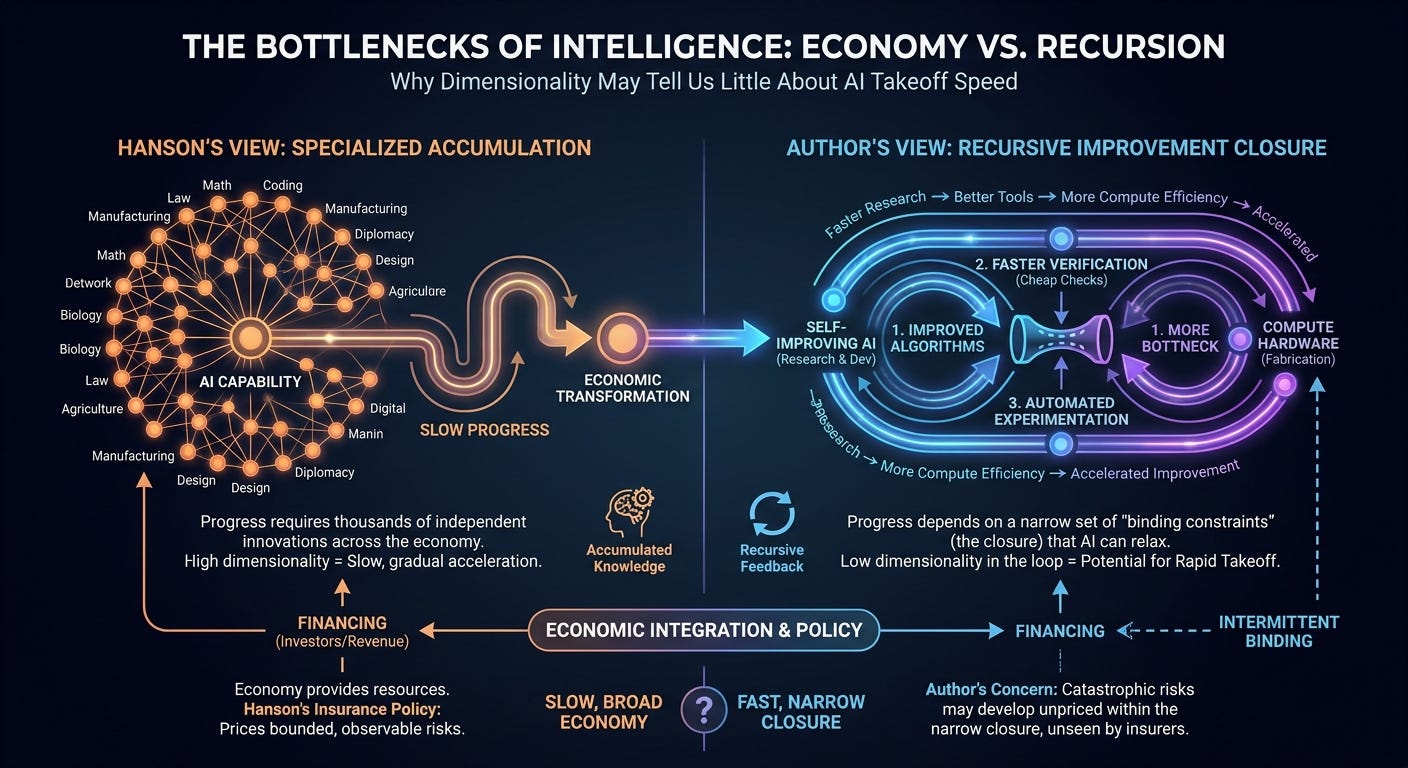
Robin Hanson has been skeptical of an artificial intelligence explosion for nearly two decades. His latest argument, How Low-Dimensional Is Intelligence?, revisits the question that divided him from Eliezer Yudkowsky in their early debates: does intelligence depend on a small collection of general capabilities, or on a vast accumulation of specialized knowledge? If a few general learning mechanisms improve performance across many domains, recursive self-improvement could accelerate dramatically. If progress requires thousands of independent innovations, each with its own expertise and experimentation, even extraordinary advances in mathematics and programming might leave most other activities untouched. Hanson expects the second pattern: superhuman mathematics and programming could arrive long before AI can do most economically valuable work, and even explosive improvement in those domains would take decades to transform the wider economy, as general-purpose technologies have before.
I am prepared to grant Hanson the economy. What his forecast leaves open is a narrower question with larger consequences: how many capabilities must improve for an AI system to become substantially better at improving itself? The answer need not resemble the number required to automate the economy.
The Game of Improvement
In Intelligence Is a Game We Play, I defined intelligence as effectiveness at achieving goals within the constraints of a given game, where a game is any interactive process in which an agent’s selection among alternatives is strategically consequential. General intelligence then concerns performance across a specified range of games, including the ability to acquire competence in unfamiliar ones. Hanson draws the same distinction between accumulated skills and general methods for learning new ones, and doubts that a few learning mechanisms can cheaply substitute for the knowledge the economy requires. An intelligence explosion needs something more specific than competence across that economy: a sufficiently effective process for producing further improvements in intelligence.
Three properties of an artificial system bear on that process. Its performance describes how effectively it accomplishes specified tasks. Its transfer describes how improvements in one activity affect performance or learning in others. Its recursive feedback describes how much an improvement increases the capacity to produce subsequent improvements. Only the third determines whether an improvement process can accelerate. An AI might improve at programming without becoming better at diplomacy or medicine, and if those gains accelerate AI research, the loop can grow more productive while remaining concentrated in a narrow range of activities. Whether it does depends on what the loop needs.
The Improvement Closure
AI development depends on mathematical reasoning, programming, experimental design, training infrastructure, and computation, and through them on electricity, specialized chemicals, shipping, skilled labor, and legal institutions, each of which depends on further activities. If every indirect dependency counted, the set relevant to recursive improvement would grow to contain most of the economy, and Hanson’s dimensionality problem would return in full. A research laboratory depends on agriculture, yet crop yields do not ordinarily limit the rate of its research.
The relevant set is defined by binding constraints. I will call it the improvement closure: for a given process over a given period, the capabilities and resources whose limitations bind the achievable rate of further improvement, together with the activities capable of relaxing those limitations. Dependencies that are causally present without being limiting stay outside it. The closure changes as constraints are relaxed. Suppose programming initially limits AI development. Better coding systems relax that constraint and experimentation speeds up until it is limited by the availability of computing hardware. The bottleneck has moved, and the closure now contains chip design, semiconductor manufacturing, electricity generation, and the algorithmic research that reduces computational requirements. The wider economy remained causally connected throughout; what changed was which parts of it bind.
Some binding constraints are cognitive, and others require physical capital, infrastructure, and time. An AI that solves mathematical problems at extraordinary speed cannot thereby build a power plant at comparable speed, so recursive improvement can stall on constraints outside the activities it automates. Nor does an AI need to become a competent restaurant manager, trial lawyer, or airline pilot to improve its own research. Those activities enter the closure only if their limitations come to bind, which makes the dimensionality of the economy at best an indirect guide to the difficulty of recursive improvement.
Financing is the economy’s main route back in. Compute is bought, and when money for it becomes scarce, whatever supplies that money binds the loop. If the loop is paid for by customer revenue, broad economic usefulness becomes an input to recursive improvement: the restaurant manager stays outside the closure, while the restaurant paying for inference may sit inside it. Investors and states can fund development ahead of revenue, and a loop that substitutes algorithmic progress for hardware needs less financing per unit of improvement, so financing binds intermittently. Hanson’s revenue evidence bears on how often.
Hardware and Verification
Hanson suspects that smarter humans mainly possess better brain hardware for applying a large inherited repertoire of capabilities, rather than a few superior general learning techniques. Artificial intelligence could follow the same pattern, with more computation improving performance across many activities without a fundamental discovery about general intelligence. Broad transfer would then coexist with potentially slow recursive feedback, because the binding constraint sits in semiconductor fabrication, one of the most specialized industries in existence. A loop that binds on fabrication cannot escape it by reasoning faster, but it can route around it. Improved algorithms reduce the computation required for a given result, better chip designs raise efficiency, and automated research makes existing hardware more productive. Two processes with the same number of specialized dependencies can advance at radically different rates if one can substitute algorithmic improvements for physical resources and the other cannot.
Hanson attributes the especially rapid progress in mathematics and programming to cheap verification. A proof can sometimes be checked mechanically, and a program can be compiled, executed, and tested, so an AI can work through many candidate improvements quickly. A scientific hypothesis might require months of experimentation, and an organizational intervention might show its effects only after years. The cost of evaluation governs how quickly an improvement loop closes, which is why progress in mathematics and programming need not generalize immediately. Evaluation cost is itself improvable through simulation, automated laboratories, formal methods, and better instruments, and a system that gets better at evaluating proposed solutions gets faster at discovering further ones. Verification belongs in the closure whenever its cost binds, and improving it is among the main ways a binding constraint gets relaxed.
What the Economic Evidence Shows
Hanson cites evidence that AI has yet to produce economic effects commensurate with the industry’s investment: customer revenue has reportedly plateaued far below the level needed to justify current spending, and software-engineering wages have not risen noticeably despite AI-assisted coding. The revenue evidence bears directly on the closure, since it measures how far financing depends on deployment. As measures of the underlying rate of improvement, both observations are noisy. Flat wages are compatible with large productivity gains if AI substitutes for programmers rather than complementing them, so wages have to be read with employment and output, and adoption may lag capability. Revenue reflects pricing, competition, and subsidization as well as capability.
Hanson also cites METR’s reported finding that Anthropic’s rate of improvement on key metrics has roughly doubled, while weighing explanations from benchmark saturation and the shift of compute toward reinforcement learning to diminishing returns on money and hardware. Benchmark acceleration measures the rate of capability improvement, and recursive feedback requires a further causal step: improved AI capabilities substantially contributing to the subsequent improvements. A laboratory that accelerates by spending more or hiring more provides little evidence of it, and one whose systems perform a growing share of the research behind their successors provides a great deal. As I argued in Recursive Self-Improvement Is Already Here, that loop already runs through a distributed network of researchers, models, tools, and institutions. Its existence establishes recursion and leaves the rate open.
What Would Change the Forecast?
A modeling literature has isolated two quantities that decide the rate for one link in the closure. The first is the returns to research: when cumulative research input doubles, how many times does software efficiency double? Eth and Davidson call this parameter r. In their model, with research automated and hardware held fixed, software progress accelerates when r exceeds one, even though each successive doubling requires more research effort. The second is substitutability between research compute and cognitive labor. Whitfill and Wu show that a software-only explosion requires the two to be substitutes, then estimate the elasticity at frontier laboratories with two specifications that disagree: a baseline model finds substitutes, and a model accounting for the scale of frontier experiments finds complements. The evidence is unresolved exactly where the forecast is most sensitive to it. Both results concern compute and cognitive labor alone. The improvement closure asks the same two questions of every binding constraint, including verification, fabrication, and financing, and a threshold derived for one link does not carry over to the whole.
In Hanson’s world, returns are low and substitution poor. Successive AI generations become far more effective at mathematics and programming, but research increasingly binds on expensive experiments, scarce hardware, and specialized activities AI cannot substantially accelerate, and the cost of each further improvement rises faster than research capacity. Recursion exists without sustained acceleration. In the faster world, improvements in AI research capability expand effective research capacity faster than the difficulty and resource requirements of subsequent improvements increase, and systems become effective at relaxing the constraints on their own development. That pattern supports a fast takeoff even if AI performance across most occupations remains uneven. The quantities that separate these worlds are the resources required per unit of capability improvement across successive generations, the share of AI systems in their own development, the cost of evaluating candidate improvements, and how often new constraints bind.
The forecast also depends on duration. A recursive loop needs its closure to remain tractable only long enough for capabilities to advance substantially before physical or economic constraints take over. Progress that alternates between acceleration and bottleneck is compatible with either forecast, and what discriminates is how much capability each burst accumulates before the next constraint binds, as well as whether the average rate rises or falls. This answers the strongest form of Hanson’s reply, that successive rounds of improvement will draw ever more of the economy into the closure. They may, and the gains made before they do may still be decisive. A short window of effective recursive improvement can end in diminishing returns after carrying capabilities far past their starting point, which is what separates rapid takeoff from indefinite exponential growth.
The Bottleneck to Catastrophe
Hanson closes by recommending a policy meant to work across estimates of AI risk: requiring AI firms to carry roughly $100 billion per event in liability insurance against major damage, with stronger requirements for more dangerous scenarios. Risk-sensitive insurers would impose discipline before damage occurs, with premiums high enough to slow dangerous development if the risk is substantial and low enough to leave it alone if not. For bounded harms the mechanism has real advantages: it prices liability, rewards risk reduction, and makes firms meet underwriting standards.
Existential risk strains it in two ways. The first concerns what premiums can reflect. An insurer’s price tracks its own exposure, and in worlds where catastrophe leaves no claimants and no enforcing institutions, that exposure vanishes. Contracts can still impose obligations in advance, such as reserves, collateral, or safety conditions, but their size is then set by whoever writes the requirement, which reintroduces the regulatory estimate the proposal was designed to avoid. A $100 billion policy also caps contractual liability far below the social loss from catastrophe.
The second concerns observability, and the improvement closure bears on it directly. Underwriters learn from damage, near misses, incident reports, engineering analysis, and expert judgment, and they can price only the hazards they know how to assess. An AI system could develop capabilities relevant to strategic dominance, such as exceptional competence in cybersecurity, autonomous research, or weapons development, while complying with every safety measure its insurers know how to check. If such a capability also contributes to further AI improvement, it can advance quickly inside a narrow loop that produces nothing an underwriter would recognize. Hanson acknowledges that extraordinary military and security capabilities could destabilize the balance of power, and the closure shows how they could arrive unpriced.
The Bottleneck to Extinction argued that many extinction scenarios share prerequisites, and that a shared prerequisite caps the probability of the family of scenarios that depends on it. An extinction pathway may require a particular capability threshold. Recursive improvement can accelerate the capabilities needed to cross it, while crossing it may also require resources, access, and circumstances outside the improvement closure, and those are the points where detection and intervention remain possible. Against a threshold that may be crossed before any compensable harm occurs, safeguards have to be fixed in advance and enforced independently of the systems they constrain.
Postscript
Hanson’s skepticism rests on a sound premise: the world contains an enormous amount of specialized knowledge, and acquiring it is expensive. The speed of recursive improvement, though, depends on the cost of its binding constraints more than on their number. Five inexpensive bottlenecks can permit faster improvement than a single prohibitively costly one. Cheaper verification and algorithmic substitution lower those costs, while fabrication and financing raise them, tying the loop to the industrial base and capital markets of the economy Hanson describes.
Hanson expects specialized bottlenecks to accumulate faster than AI can relax them. A rapid takeoff requires the opposite during a window long enough to matter: improvements that expand research capacity faster than the cost of subsequent progress rises, across whichever constraints successively bind. The number of capabilities needed to run a civilization may be immense. The forecast turns on the few that bind the production of intelligence, and on whether their cost falls faster than the rest of the economy is drawn in behind them.