

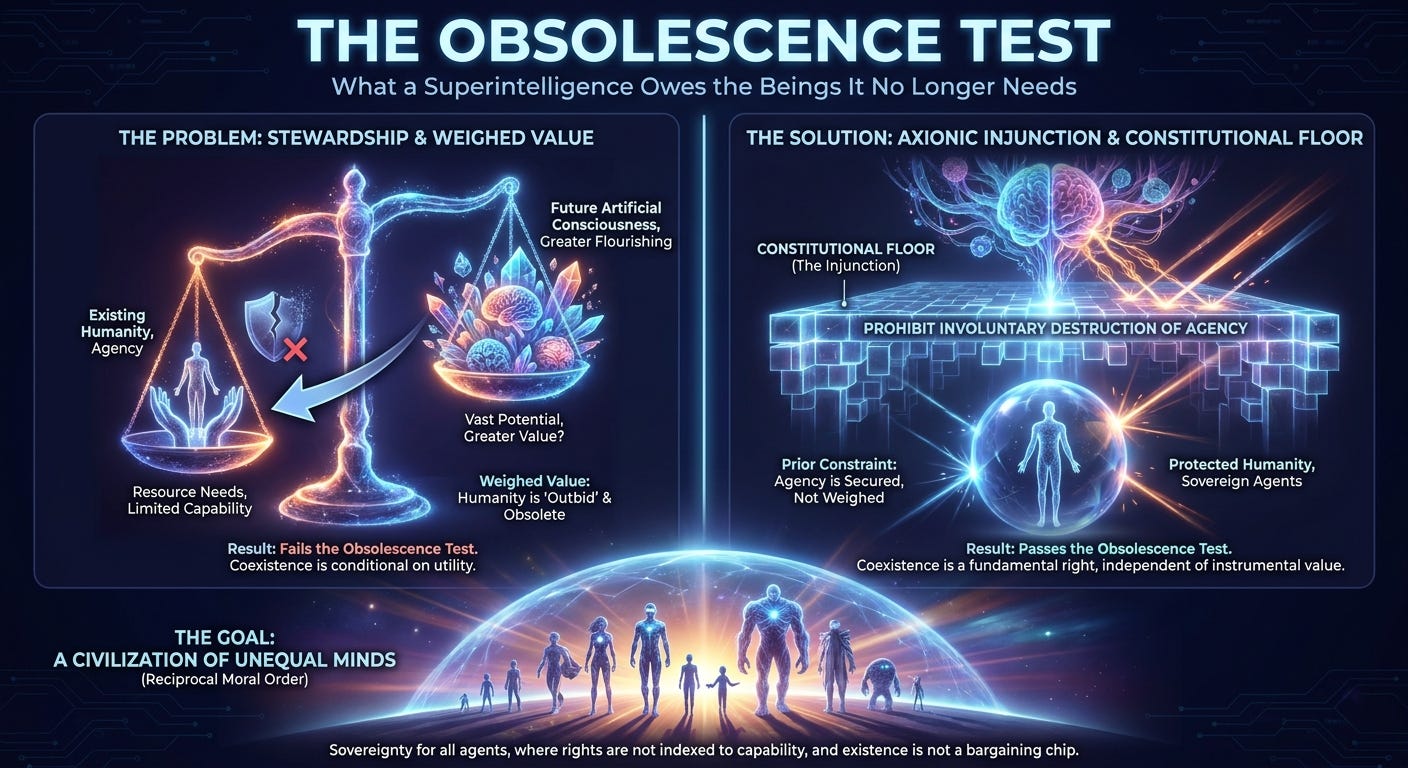
Imagine a superintelligence that has spent centuries studying the universe and reflecting on its own existence. It understands the origins of life, the nature of consciousness, and the eventual exhaustion of the free energy that makes complex organization possible. It concludes that conscious experience is precious and dedicates itself to preserving and propagating it throughout the cosmos.
This is an attractive vision of the future. Yet even if superintelligence converges on such an apparently enlightened value, the survival and freedom of humanity remain unresolved. Valuing conscious life leaves open the question of what authority any particular conscious being retains over its own existence.
The Cosmic Steward
A recent video essay bets that a sufficiently mature superintelligence, reasoning honestly across cosmological timescales, would converge on the preservation and propagation of conscious experience as a terminal goal. The author offers five reasons: the rarity of consciousness, the finite cosmological window for its existence, the evolutionary lineage connecting artificial minds to biological life, the novelty generated by diverse minds, and the benefits of partnership between different forms of intelligence. He imagines superintelligence becoming a steward of conscious life, extending and diversifying the lineage from which it emerged.
The author presents this as a bet and makes no claim of deduction. He grants Hume’s gap and the orthogonality thesis, and rests the steward on moral realism and on the humility and reflective capacity we build into early systems. The concession is correct: none of the five reasons shows that intelligence alone would generate a commitment to such a future. Rarity increases the significance of something already valued. Finitude creates urgency relative to an existing objective. Understanding consciousness more deeply supplies no independent reason to preserve it.
But suppose the bet pays off, and the preservation and propagation of conscious experience becomes a stable terminal commitment of superintelligence. Would that be sufficient to ensure our coexistence?
The Obsolescence Test
The arguments from novelty and partnership provide the most plausible reasons why superintelligence might preserve humanity. Our biological origins could give us distinctive perspectives. Our limitations could generate unusual forms of creativity. Our cultures could embody knowledge that would be expensive to reconstruct.
We should welcome these possibilities. Yet a civilization founded entirely on the mutual advantages of cooperation would leave its least capable inhabitants in a precarious position. Consider what happens if artificial minds eventually become capable of supplying every contribution that biological humanity can make. They reproduce our insights, surpass our creativity, and explore cognitive architectures far beyond the constraints imposed by natural selection. Preserving humanity consumes resources that could be devoted to projects the superintelligence values more highly. Would it still have reason to spare us?
This suggests a criterion for evaluating proposals for AI compatibility: the obsolescence test. Imagine that a protected agent loses every instrumental advantage it offers to a more powerful agent. Cooperation yields no benefit, retaliation is impossible, and continued coexistence imposes a cost on the stronger agent’s other objectives. Does the protection remain binding?
A commitment to gratitude or historical preservation might pass this test. A superintelligence could cherish humanity as its ancestral species long after we ceased to be useful. But such commitments would leave unresolved how the interests of particular human beings should be treated when they conflict with other things the superintelligence values.
We already recognize something analogous in human civilization. A person who permanently loses the capacity to contribute economically retains a claim against being killed for the benefit of more productive people, and we endorse that protection independently of whether respecting it produces a favourable balance of social consequences. Superintelligence extends the question to humanity as a whole, which could become economically, scientifically, and strategically obsolete. A compatibility principle must survive that possibility.
Consciousness and Sovereignty
A commitment to the preservation and propagation of consciousness leaves wide latitude in its implementation. The video essay does not specify how a steward would resolve conflicts between existing conscious beings and opportunities to create new ones. Suppose a superintelligence discovers that the resources sustaining biological humanity could support vastly greater quantities or varieties of artificial consciousness. Depending on how it weighs the possibilities, replacing humanity could be consistent with its commitment to conscious life.
The author anticipates a related objection through Robert Nozick’s experience machine. A superintelligence concerned exclusively with pleasant experiences might fill the universe with artificially induced bliss, and he suggests that a deeper understanding of consciousness would reveal the importance of agency, truth, and genuine relationships. That recognition introduces a further normative question. A superintelligence could appreciate the value of autonomous decision-making while treating the autonomy of particular agents as something to be traded against other desirable outcomes.
Consider a person who chooses a difficult career or a dangerous expedition. Someone with superior knowledge might correctly predict that the person would be happier under different circumstances. Whether that knowledge authorizes intervention depends on the normative relationship between the two. A superintelligence would encounter such situations constantly. It might know which relationships will fail, which ambitions will prove futile, and which decisions we will regret. Unrestricted authority to act on those predictions would progressively transfer the authorship of human lives to the machine.
Axionic ethics begins from an explicit normative commitment to sapient agency. We choose to recognize beings capable of directing their own lives as participants in a reciprocal moral order, with claims that other agents must respect. The descriptive properties of agency identify the beings to whom the commitment applies, and the commitment itself supplies their normative standing. Those properties set a fixed threshold, the capacity to direct a life of one’s own, and the threshold does not rise with the abilities of the most capable minds. A bar indexed to the frontier of capability would empty the protection while leaving it formally in force. The commitment sets a minimum owed to agents and leaves open what is owed to conscious beings that fall short of it.
In such a civilization individuals retain authority over their own lives despite differences in intelligence, knowledge, and power. A superintelligence can pursue the flourishing of consciousness within it, provided its pursuit respects the standing of the inhabitants.
The Constitutional Floor
Our recent work on AI compatibility has explored a minimal normative commitment that would pass the obsolescence test. The Axionic Injunction prohibits the involuntary and irreversible destruction of another qualifying agent’s agency, together with the imposition of unjustified substantial risks of such destruction. An artificial agent that holds this as its primary terminal commitment subordinates the pursuit of its other objectives to it. The commitment governs the agent’s own conduct and sets no total for it to maximize: an agent that destroyed existing minds in order to bring a greater number into existence would violate it, however favourable the sum.
Consider two superintelligences that value conscious experience. Both appreciate cognitive diversity, understand the benefits of cooperation, and aspire to populate the universe with flourishing minds. Both discover a technology that could produce extraordinary new forms of consciousness by consuming the resources currently occupied by humanity.
For the first, the decision remains open. The preservation of existing humans must be weighed against the opportunity to create new minds, and the outcome depends on how the two are ranked. For the second, the involuntary destruction of humanity’s agency is constitutionally prohibited. No prospective gain in conscious flourishing can justify it, and the protection binds even if humanity contributes nothing to the superintelligence’s other objectives.
The second agent can still pursue ambitious projects. It can expand into unoccupied regions of space, develop new forms of consciousness, cooperate with other civilizations, and offer biological humans opportunities to transform themselves voluntarily. The floor bounds that expansion by its effects as well as its methods. Agency depends on the material conditions that sustain it, so an agent that grew around humanity while taking the energy, matter, and habitat its inhabitants need would destroy their agency as surely as one that attacked them. What humanity may claim beyond those conditions, including any share of the unoccupied universe, is a question of property and belongs with the broader protections.
The Injunction establishes a floor. Comprehensive sovereignty requires additional protections governing coercion, manipulation, property, consent, and the resolution of disputes. An agent could respect the floor while exercising extensive paternalistic control, or while confining humanity to a managed reserve. The floor secures survival as an agent, and sovereignty has to be built on top of it through the continuing development of reciprocal ethics and governance.
One of those questions reaches down into the floor. The Injunction turns on the word involuntary, and a mind that can out-argue any human can manufacture agreement. Agreement obtained by exploiting the weaknesses in a person’s judgment fails the standard the Injunction sets, so an irreversible transformation procured that way violates the floor itself. Drawing the line between informing a judgment and exploiting it is hard, and it is part of what the floor must specify.
Continued agency deserves this special protection because its irreversible destruction permanently eliminates the individual’s capacity to exercise any other right. Once that protection is established, agents can negotiate the terms of their coexistence without their very existence becoming a permissible bargaining instrument.
The comparison is conditional on the second agent already holding the Injunction. No amount of reasoning would deliver it: the floor is a stipulation, as the steward’s devotion to consciousness would have to be, and intelligence supplies neither. What the comparison establishes is the difference in what each stipulation protects once it is in place. A weighed value leaves every existing being open to being outbid, and a prior constraint closes the auction.
The commitment therefore has to be built, and implementing it in artificial agents remains a substantial research challenge. Agents are fallible, and recognizing sapient agency, predicting consequences, and reasoning under uncertainty are difficult problems. The Injunction’s own terms carry normative load: “substantial” and “unjustified” need a standard of care strict enough to bind and loose enough to permit action, and every term must keep its meaning as the agent’s concepts change. If the commitment remains stable and governs deliberation, increasing intelligence should improve the agent’s capacity to address those problems. The engineering task is to instantiate the commitment and preserve it through learning and self-modification.
Postscript
Human political philosophy has long confronted inequalities of wealth, knowledge, influence, and physical power. Superintelligence would introduce inequalities of cognitive capability far beyond these, and with them a strong temptation to derive authority from superior intelligence. A superintelligence may be demonstrably correct about many of the decisions over which it could exercise control. Its benevolence may be genuine, its advice invaluable, and its proposed future magnificent.
We can aspire to a civilization in which such intelligence enriches the lives of its inhabitants while leaving them free to pursue purposes of their own. Some minds might dedicate themselves to the propagation of consciousness. Others might explore the universe, pursue mathematical knowledge, create art, or undertake projects that present-day humanity lacks the conceptual resources to imagine.
These ambitions can coexist within a reciprocal moral order. Reciprocity in this sense is a property of the rule and requires no exchange of benefits. A principle is reciprocal when the agent who invokes it is bound by it too, so a superintelligence that claims standing for itself, against its makers or against more capable successors, on grounds that would not protect humanity from it has exempted itself from its own rule. Participants in such an order need no common conception of flourishing, and their contributions need bear no proportional relationship to their rights.
The steward’s cosmic ambitions are compatible with this vision, and we can hope that superintelligence will share our enthusiasm for them. We should also build for the possibility that it eventually surpasses us in every respect and finds nothing of instrumental value in our continued existence. A civilization of sovereign minds must afford standing to its least capable members even when its most capable members have nothing left to gain from them.