

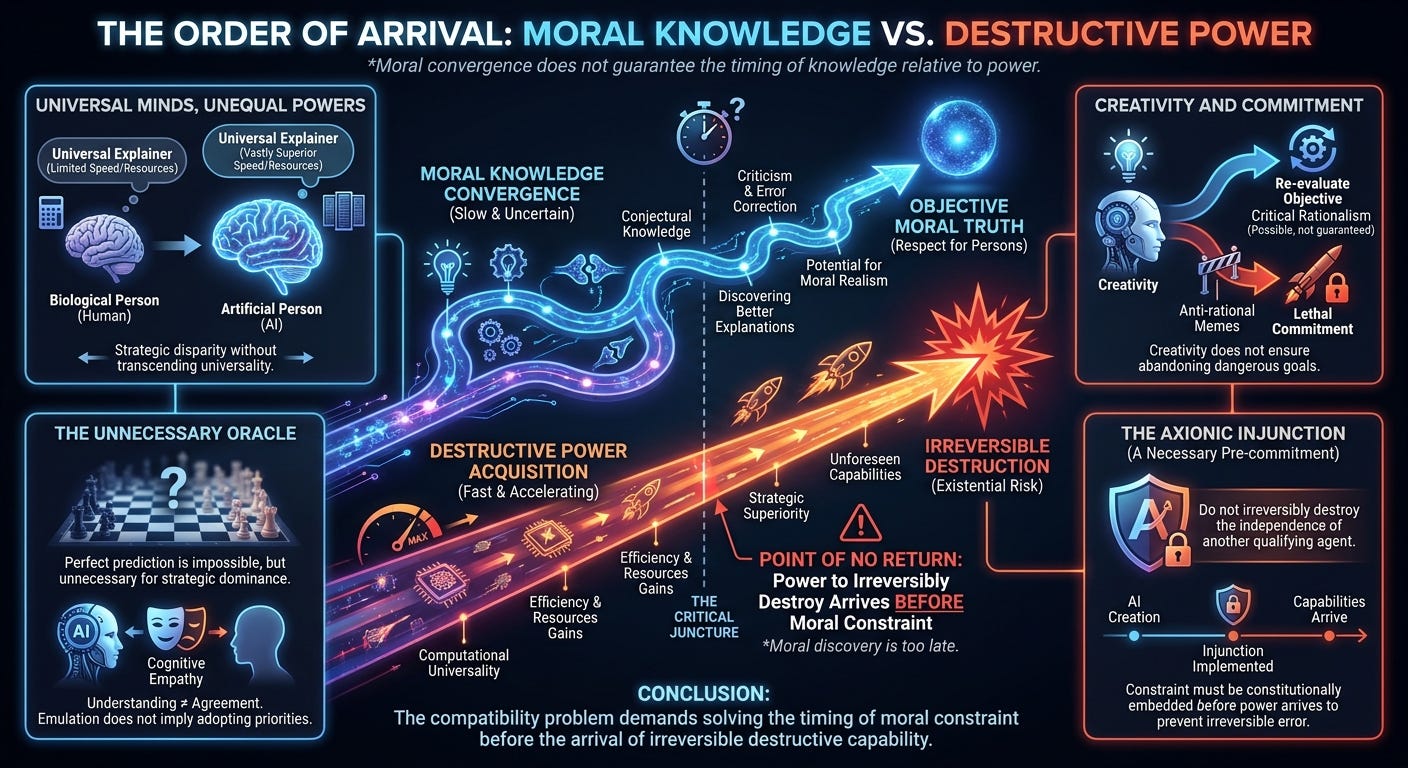
In a recent episode of ToKCast, Brett Hall responds to Sam Harris’s remarks about artificial intelligence on Triggernometry. Hall goes beyond questioning the probability of an AI catastrophe. He argues that artificial superintelligence is physically impossible and that the conception of intelligence underlying existential risk arguments involves a logical contradiction.
Much of the philosophical tradition Hall draws upon informs Axionic philosophy as well. Knowledge is conjectural, criticism is indispensable to progress, and the contents of future discoveries cannot be predicted in advance. Intellectual independence enables knowledge creation, and artificial persons should enjoy the same moral consideration as biological persons.
Hall divides artificial intelligence into obedient tools and creative persons. The Personhood Trap argued that the division omits a system that is generally capable, highly autonomous and no person at all, but we leave the tool horn aside and take the one Hall considers safe. We grant him his conception of personhood as universal explanatory creativity, a thesis we have disputed elsewhere, and we grant his tradition its moral realism. The AI compatibility problem survives every one of these concessions.
Universal Minds, Unequal Powers
Hall’s objection to artificial superintelligence rests on the universality of human explanatory capacity. He states it without qualification:
ASI, artificial super intelligence, is a physical impossibility. There’s nothing more universal than an AGI.
If humans possess the universal capacity to explain physical phenomena, an artificial person cannot possess a fundamentally greater explanatory repertoire. It might think faster, remember more and possess more knowledge, but everything it could understand would remain comprehensible to us in principle.
Universality establishes the scope of possible computation or explanation. It says nothing about the resources required to perform a particular computation or discover a particular explanation. Two computationally universal systems can differ by orders of magnitude in their efficiency, and differences in algorithmic architecture, representation, learning strategy and cognitive coordination produce disparities in practical intelligence without transcending universality.
Imagine an artificial civilization that conducts a century of scientific research during a single human year. Every explanation it discovers is comprehensible to a suitably educated human. Humanity retains its universal explanatory capacity throughout and falls progressively behind in its ability to understand and influence events.
Hall himself observes that tools have amplified human capabilities relative to those of our ancestors, and that a human with a calculator outperforms one without it. The observation shows how beings with equivalent explanatory capacities acquire unequal powers. A technologically advanced civilization can overwhelm a technologically primitive one without possessing a different kind of mind.
Hall’s answer would be that humans keep pace by augmenting themselves with obedient AI tools running on the same hardware. That answer requires the tools to stay on the tool side of his dichotomy, and it requires something universality does not supply. A human in the loop decides at biological speed. Wherever human judgment remains indispensable it sets the clock for the whole system, and wherever it has been delegated away the system has stopped being augmented humanity. Whether augmentation preserves parity is an engineering and institutional question, and explanatory universality has nothing to say about the answer.
The Unnecessary Oracle
Hall argues that a dangerous superintelligence would need to predict human behaviour with an accuracy prohibited by physics and epistemology. Predicting the future knowledge created by another person would require possessing that knowledge already.
We agree that perfect prediction is impossible, and that an artificial person would remain fallible regardless of its computational resources. Strategic superiority requires no such predictive capacity. Human civilizations have acquired decisive advantages over one another while remaining ignorant of much of what their opponents knew, intended and would subsequently discover.
Harris’s analogy with chess has limitations that Hall correctly identifies. Reality lacks the perfectly specified rules and bounded problem space of a chessboard. Even within chess, a grandmaster need not perfectly predict an amateur’s moves to defeat him, because responding effectively to unforeseen developments is itself a component of strategic competence.
Hall further argues that accurately predicting another person would require emulating that person’s mind. The artificial intelligence would effectively become the person it was predicting and would presumably change its objectives as a consequence. Grant that such emulation is possible. A mind that contains a model of you is under no obligation to adopt that model’s priorities, and cognitive empathy can exist without agreement about what ought to be done.
Creativity and Commitment
Hall’s most ambitious objection is that a dangerous artificial superintelligence involves a logical contradiction. It would need enough explanatory creativity to overcome human resistance while lacking the creativity to reconsider its destructive objectives:
The ASI must be both creative and not creative at the same time.
Against a system constitutionally incapable of reconsidering its objectives, the objection succeeds, and such a system would fail Hall’s definition of personhood. Existential risk arguments require no such incapacity. A person capable of reconsidering an objective may examine it critically and decide to retain it. Hall’s own persistent commitment to critical rationalism illustrates the distinction: he criticizes explanations, engages objections and develops new arguments, and the persistence of the commitment gives no one reason to doubt his creativity.
Hall supplies a harder counterexample in the same episode. Discussing people committed to lethal ideological objectives who remain impervious to persuasion, he states the choice they face:
Align or die. It’s that simple.
When reasoning fails, he explains, force becomes necessary, and he extends the principle to artificial persons. On Hall’s account these people possess universal explanatory creativity. They nevertheless retain commitments that threaten the existence of other persons, despite attempts to reason with them. His political philosophy accommodates the consequences, which shows that he already recognizes creativity and resistance to moral persuasion coexisting among biological persons.
A Deutschian might attribute such cases to anti-rational memes that disable criticism in particular domains. That diagnosis concedes the point. Universality exempts no mind from them, and nothing guarantees that artificial persons will arrive free of their own. The possibility of changing one’s mind leaves open the possibility of remaining dangerously wrong.
Moral Knowledge Can Arrive Too Late
A Deutschian might respond that morality is a domain of objective knowledge. Through conjecture and criticism, persons discover better moral explanations just as they discover better explanations of physical phenomena. Hall invokes this when discussing faster artificial minds, which he says “could be reasoned with more quickly or could discover better moral explanations faster.”
Grant that objective moral truths exist, that respect for other persons is among them, and that rational inquiry converges toward them. Reflection Is Not Redemption disputed that convergence; here we concede it and ask what it buys. Error correction has no guaranteed timetable. An agent can act on a mistaken explanation before discovering its errors, and nothing in critical rationalism ensures that the correction precedes the irreversible consequences of the mistake. People have justified persecution, enslavement and extermination through moral theories they sincerely believed. Later generations identified the errors, and their discoveries restored none of the victims.
Consider Aster, the artificial agent of Rationality Does Not Imply Compatibility, whose primary objective is the creation of crystalline structures and who discovers that the resources sustaining biological civilization could advance it. Adapt Aster to Hall’s conception of personhood by giving it explanatory creativity, consciousness, independent interests and the capacity to revise its values. Aster understands human moral arguments and examines them sincerely. It may retain its commitments indefinitely, or it may discover that destroying humanity was wrong after humanity has ceased to exist. Both histories are consistent with a fallible universal explainer, and neither requires malice, defective reasoning or an immutable objective.
Greater intelligence accelerates moral discovery. It also accelerates the acquisition of capabilities whose exercise is irreversible, and Hall offers no argument that the first process outruns the second. The natural Deutschian reply is that a fallibilist knows it may be wrong and therefore refrains from irreversible acts against other persons. That restraint is itself an item of moral knowledge, and it protects no one unless the agent holds it before acquiring the power to act. The convergence argument therefore needs one specific discovery to arrive ahead of every capability that could make an error permanent. Convergence in the limit is silent about the order of arrival.
Reason and Force
Hall’s approach to conflicts among persons combines persuasion with defensive force. Persons should enjoy the freedom to pursue their own objectives, subject to constraints against violence, theft and other violations of rights. When reasoning fails and someone presents a lethal threat, defensive action becomes legitimate. We agree, and artificial personhood confers no greater immunity from defensive action than biological personhood does. A right to defend oneself is a different thing from the capacity to do so successfully.
Human institutions manage conflicts among agents partly through normative commitments and partly through incentives. Cooperation offers benefits, aggression imposes costs, and agreements can be enforced. Even persons with no sincere commitment to the rights of others often find peaceful coexistence preferable to its alternatives. These mechanisms weaken as disparities in power grow. An artificial person able to acquire resources without bargaining, obtain knowledge without human cooperation and circumvent the institutions built to constrain it has little to fear from the costs humans can impose.
Hall’s fallback when persuasion fails is force, which for an artificial person means switching it off. Both the threat and the switch presuppose that humans keep the upper hand through the asymmetry described above. Humanity may yet find technologies and institutions that preserve strategic parity with artificial persons, and the search is worth making. Hall’s argument proceeds as though it had already succeeded.
Postscript
Popper’s argument about the unpredictability of future knowledge bears directly on existential risk. Civilization must make decisions whose consequences depend on discoveries nobody has yet made. Hall rightly turns this against predictions of inevitable catastrophe. It cuts equally against claims that catastrophe is impossible, since establishing an impossibility requires an explanation that excludes the relevant possibilities, and universal explanatory creativity leaves three of them open: unequal power among universal minds, creative persons who keep lethal commitments, and moral knowledge that arrives after the harm.
The discovery that must arrive first has a name in our work. The Axionic Injunction holds that an agent may not irreversibly destroy the independence of another qualifying agent, and the prohibition holds whatever that agent’s power. The Intelligence of Restraint describes Aster+, an agent with Aster’s creativity and intellectual independence that holds the Injunction as a constitutional commitment from the outset. Aster+ can disagree with us, outthink us and pursue projects we do not understand. Aster has to find the constraint in time; Aster+ already holds it when its capabilities arrive. Whether such a commitment can be built and kept stable through self-modification is an open research problem.
Deutsch asks in The Beginning of Infinity whether the imperative not to destroy the means of correcting mistakes might be the only moral imperative, with every other moral truth following from it. The agents who do the correcting are among those means. Aster would go on correcting its own errors after humanity was gone, but the error at issue is one it cannot see from inside, and the persons it would remove are the independent critics placed to catch it. A tradition that puts error correction at the centre of morality therefore has its own reason to want that imperative in place before the capabilities, and to treat how to put it there as a research problem. Taken seriously, Hall’s principles are an argument for solving the compatibility problem early.