

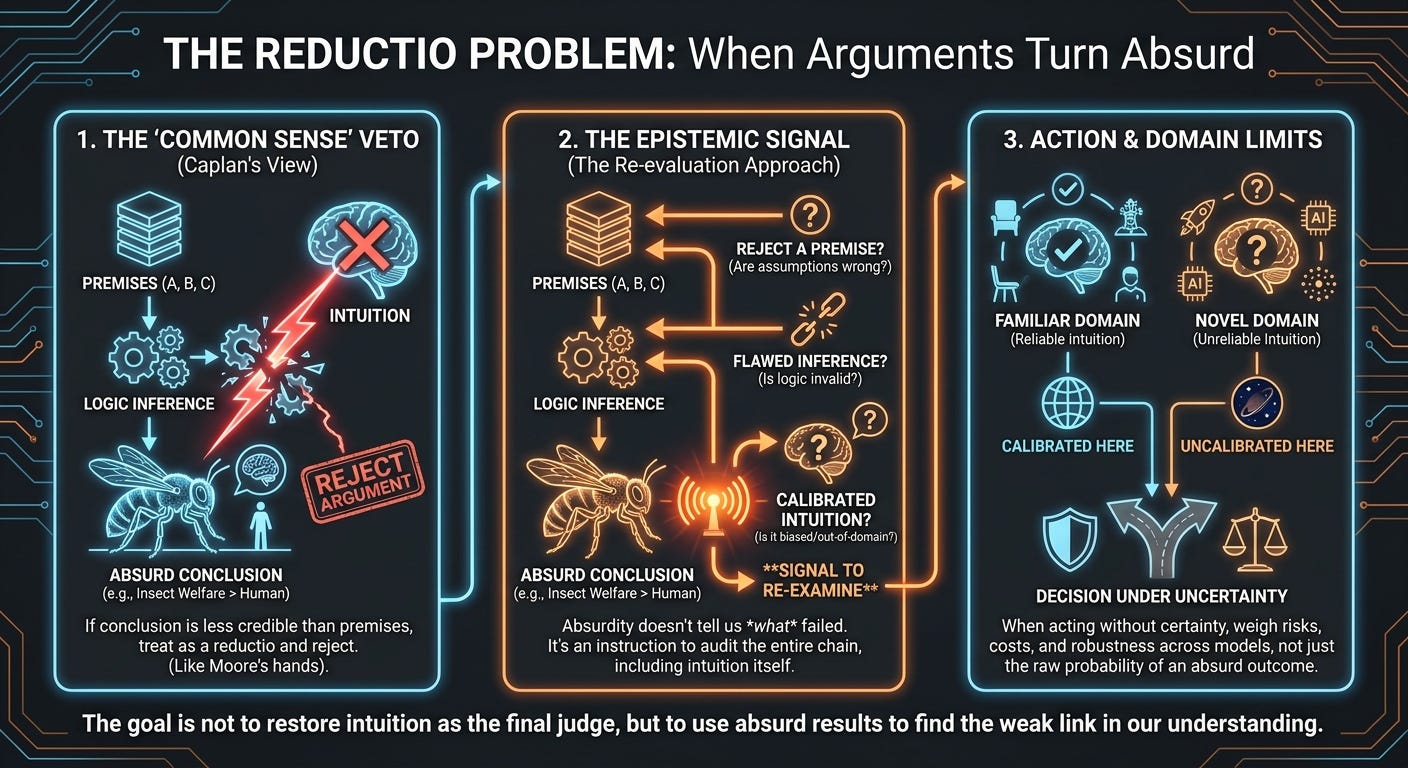
Suppose a careful argument leads to the conclusion that the suffering of insects matters more than the suffering of humans. Something has gone badly wrong. Or perhaps it has not. Perhaps insects really are conscious, there really are vastly more of them, and our moral intuitions were built for a world in which nobody had to aggregate welfare across trillions of radically different minds.
The difficulty is that the absurdity of a conclusion does not tell us which of those possibilities is true. It tells us that something deserves another look.
Bryan Caplan recently argued that Effective Altruism has lost precisely this capacity for common-sense error correction. His cases are AI extinction risk and insect welfare, the second built on a reductio he published a decade ago and which some EAs have since simply accepted. If an argument reaches something sufficiently implausible, Caplan argues, the denial of that conclusion becomes more credible than the premises used to derive it. At some point, common sense gets to say no.
Caplan’s argument trades on two senses of reductio. A strict reductio derives a contradiction from an assumption. Informal reductios are weaker: they derive a conclusion judged less credible than the premises required to reach it. In ordinary argument, this happens constantly. We follow a line of reasoning to something bizarre, repugnant, or deeply counterintuitive, then treat that reaction as evidence that something upstream must be wrong.
Sometimes that is exactly the right move. But “counterintuitive” is not the same thing as “contradictory.”
If accepting proposition A entails both B and not-B, A must go. If accepting A entails that insects deserve substantial moral consideration, we have learned something very different. Either A is wrong, some other premise in the derivation is wrong, the inference is wrong, or insects deserve substantial moral consideration.
The weirdness of the last possibility cannot decide among them.
When Intuition Pushes Back
None of this means intuition is worthless. A conclusion that violently conflicts with everything else we think we know should cause a substantial update against the argument that produced it.
Human intuitions are not random noise. They encode experience, evolved cognitive machinery, and cultural learning. If a model says that jumping from a window on the twentieth floor is safe, the model probably contains an error. We do not need to solve the relevant differential equations before refusing to jump.
But that makes intuition evidence, not authority. Our intuitions are themselves outputs of models, calibrated in particular environments for particular purposes.
Sometimes the strange conclusion is the error. Sometimes the intuition is.
The history of inquiry contains enough examples to make any general intuition veto untenable. The Earth moves. Species are not immutable. Time does not pass at the same rate for every observer. Matter behaves in ways that resist any straightforward picture inherited from ordinary experience. None of those propositions became true because they were counterintuitive, but neither could their counterintuitiveness settle the question against them.
An astonishing conclusion creates an epistemic problem. It does not solve one.
The Missing Step in the Reductio
Caplan makes the epistemic structure explicit. If A entails B, but we have greater reason to believe not-B than A, then the conflict gives us reason to reject A rather than accept B. In practice A is a conjunction of premises, and the conflict tells us only that at least one of them must go.
The hard part is establishing that asymmetry.
Consider insect suffering. Suppose we begin with premises that conscious suffering has moral significance, that moral significance does not depend simply on species membership, and that at least some insects have a non-negligible probability of phenomenal experience. Combine those with the enormous number of insects and we may reach conclusions that strike almost everyone as grotesquely disproportionate.
Perhaps that is a reductio of one of the premises. But which one?
Maybe insects are not conscious. Maybe consciousness does not occur in degrees comparable across radically different nervous systems. Maybe welfare cannot be aggregated in the assumed way. Maybe expected-value reasoning becomes unstable when applied to probabilities we cannot meaningfully calibrate. Some versions of the argument begin to resemble Pascal’s Mugging: a tiny or poorly grounded probability is multiplied by an enormous quantity until it dominates everything else. Insect Ethics presses that objection against the insect case directly. Maybe our human-centred intuitions are biased toward organisms that look and behave like us. Several of these could be true simultaneously.
“This conclusion is absurd” distinguishes none of them.
That is no objection to rejecting the conjunction. A sufficiently lopsided asymmetry licenses rejection before anyone finds the defective step. It is an objection to thinking the rejection taught us anything. The absurdity tells us to reopen the model, not which component failed.
The Bayesian Trapdoor concerned evidence smuggled across inferential steps it did not support. The Bias Before Bayes concerned rigorous-looking updating performed inside a badly constructed hypothesis space with poorly justified priors and likelihoods. Here we can grant that the inferential steps are visible and the assumptions stated. The result still looks insane.
Now what?
The Moorean Move
Caplan’s position is stronger than “trust common sense.” He takes his foundations from Thomas Reid: the most obvious premises are found by common sense rather than by argument, because an argument for what is self-evident must either assume it or rest on something less evident. The best-known descendant of that view is G. E. Moore’s reply to skepticism.
Moore held up his hands. Whatever abstract argument purported to show that he could not know there was an external world, he was more confident that he had hands than he was in the premises of the skeptical argument. The burden therefore ran backward. The argument had to give way.
That move is legitimate.
If I am more certain that I have hands than I am in a complicated philosophical argument implying that I do not, rejecting the argument is rational. We do this constantly. When a long calculation says that two plus two equals five, we do not suspend arithmetic until we locate the typo.
The mistake is treating every appeal to common sense as though it had the epistemic status of “I have hands.”
A Moorean shift works only when the supposedly obvious proposition is better supported than the premises assembled against it. Calling something common sense does not establish that relation.
“I have hands” rests on overwhelming perceptual and background evidence. “Insect suffering cannot outweigh human suffering” is a substantive moral and empirical judgment about unfamiliar minds. “Advanced AI cannot pose a serious extinction risk” is a substantive claim about systems that do not yet exist in mature form. Those propositions may turn out to be true, but their familiarity does not give them the same epistemic status as ordinary perceptual knowledge.
Caplan’s own list of foundations shows the gap. Perception, reason, memory, the value of human well-being, and prima facie human rights are plausible candidates for Moorean status. The claim that insect suffering cannot outweigh human suffering is not on that list and does not follow from anything on it. The value of human well-being is silent about the value of anything else.
The burden of proof can run backward. But first there has to be enough weight on that side of the scale.
Where Common Sense Is Calibrated
Common sense earns its authority somewhere. Human cognition has spent a lifetime, and in some respects an evolutionary history, learning the regularities of middle-sized objects, familiar organisms, social interaction, and ordinary causal processes. Its judgments in those domains often summarize more information than we can explicitly articulate.
Reliability does not automatically transfer across domains. Intuition about whether a chair will hold our weight has been calibrated by repeated experience. Intuition about the moral significance of a trillion unfamiliar nervous systems has not. Neither has intuition about recursively improving artificial systems, million-year civilizations, or minds running on substrates unlike brains.
The question is therefore not whether a judgment feels like common sense, but whether the processes that generated it had any opportunity to become reliable in the domain where we are applying it.
Intuitions applied outside their home domain may still encode transferable structure. But the further we move outside the conditions that trained them, the weaker their claim to automatic deference becomes.
When the World Refuses the Reductio
Imagine that future neuroscience gave us overwhelming evidence that bees were conscious. Not merely behaviour suggestive of nociception, but whatever convergent evidence we would normally regard as decisive in another animal: neural integration, flexible learning, internal state representation, pharmacological responses, and a mature theory connecting those mechanisms to phenomenal experience.
We might still dislike the moral consequences. We might discover that ordinary practices imposed suffering on staggering numbers of conscious creatures.
At that point, “but that conclusion is absurd” would not rescue us.
The example is deliberately hypothetical because our present evidence is nowhere near that strong. That uncertainty is why enormous quantitative claims about insect suffering should be treated cautiously. A reductio works only if the allegedly absurd conclusion is epistemically weaker than the premises that entail it.
The same principle applies to AI risk. Someone who derives a 99.9 percent probability of imminent extinction from a stack of speculative assumptions should receive intense scrutiny. If that person declines to borrow against a future they expect not to have, their behaviour supplies additional evidence that even they may not fully believe the number. Caplan is right that revealed preferences can expose discrepancies between professed credences and operational beliefs.
But the discrepancy does not tell us which side is wrong. Behaviour can reveal inflated rhetoric. It can also reveal inertia, compartmentalization, risk aversion, obligations to other people, or ordinary human inconsistency. And someone assigning a ten percent chance to extinction has no obvious reason to borrow without limit: in nine branches out of ten, the debt remains.
When You Have to Act Anyway
Inquiry does not always converge before action is required.
This matters most when the disputed proposition concerns an irreversible risk. We cannot run an experiment in which humanity is destroyed and then update on the result.
At that point, two questions that are often collapsed need to be separated.
What should I believe?
What should I do?
We may be unable to decide whether a low-probability catastrophic model is correct, yet still need to compare policies under that uncertainty. The relevant question is no longer which model has won, but how candidate actions perform across the models we still take seriously.
Buying a fire extinguisher can be rational without knowing the precise probability that your house will burn, because the cost is small, the protection is reversible, and the downside it addresses is large. Demolishing the house to eliminate the fire risk would require a very different evidential threshold.
A tiny speculative possibility does not acquire unlimited decision weight merely because its stipulated consequences are enormous. The reliability of the probability estimate and the costs of acting on it remain part of the decision. We have to examine sensitivity, reversibility, opportunity cost, and downside asymmetry.
A failed reductio settles neither question.
Postscript
Treat an absurd conclusion as an instruction to generate alternatives and then criticize them. The conclusion may be wrong, or a premise, or the inference. A probability may have been invented rather than estimated. Two quantities that look commensurable may not be, and a hidden assumption may dominate the result. Or the conclusion is right and the intuition is what needs revision.
This is why a strange result is epistemically valuable even when it eventually proves false. It exposes tension inside our model of the world.
A decision justified by a model should survive reasonable variations in the assumptions that bear on it. If changing one weakly grounded probability from one arbitrary small number to another reverses the decision, the model has not discovered an obligation. It has discovered its own fragility. If the conclusion persists across different formulations, alternative assumptions, independent evidence, and attempts to make it disappear, then its counterintuitiveness becomes progressively less impressive.
That is harder than invoking either common sense or the spreadsheet. It is also how fallible inquiry works.
Effective Altruism deserves criticism when enormous numbers amplify speculative assumptions into apparently overwhelming conclusions. Formalism can create an illusion of resolution that the evidence does not support. But the cure cannot be to restore intuition as the court of final appeal. Intuition is part of the evidence under examination.
When an argument ends somewhere absurd, find out what had to be true to get there.