

The last two essays in this series argued for a correction to anthropic reasoning: weigh physical possibilities instead of counting observers.
You’re Not a Random Sample argued that self-locating probability should track objective Measure rather than treating you as a uniformly drawn member of a reference class. You’re Not a Random Branch applied the same principle to Everettian quantum mechanics, where treating two branches as one each throws away the Born weights the theory supplied.
Boltzmann brains are the hardest version of the same problem.
Suppose our universe lasts for an extraordinarily long time. Thermal or quantum fluctuations may eventually produce brains whose instantaneous physical states duplicate ordinary human brains, and some could carry exactly your present memories, beliefs, and apparent observations. If such brains vastly outnumber ordinary observers, a familiar anthropic argument follows:
Most observers with your information state are Boltzmann brains. You should therefore conclude that you are probably a Boltzmann brain.
The simulation argument takes the same form. If advanced civilizations create vast numbers of simulated observers like us, and simulated observers eventually outnumber biological ones, we are supposed to conclude that we are probably simulated.
Both arguments convert multiplicity into self-locating probability, and neither supplies the conversion rate.
The centering challenge
There is a stronger case for observer uniformity than the bare assertion that you are a random sample.
Jessica Taylor, writing as jessicata, has given a Dutch-book argument for centering uniformity. An uncentered world specifies the objective physical history. A centered world adds a “here and now” location within it. Even if you know the complete uncentered world, several centers may share your information state, leaving a self-locating question about which one you occupy. Under Taylor’s assumptions, the policies that resist Dutch books all have one form. They start from a fixed measure over uncentered worlds, weight each world by how many times the agent’s information state occurs within it, and spread probability uniformly across the centers sharing that world and information state. Taylor notes the resemblance to Bostrom’s SSSA, and to SSSA combined with SIA, which differ only by a population scaling factor on uncentered worlds.
That is a Bayesian reading of the intuition behind random sampling, so dismissing the intuition as an arbitrary frequentist metaphor no longer works. Two things stay open. The measure over uncentered worlds is a free parameter of the result, constrained by nothing in the Dutch-book argument. And uniformity governs centers sharing a world and an information state, which leaves the question of whether an identical information state is the right criterion for treating two centers alike.
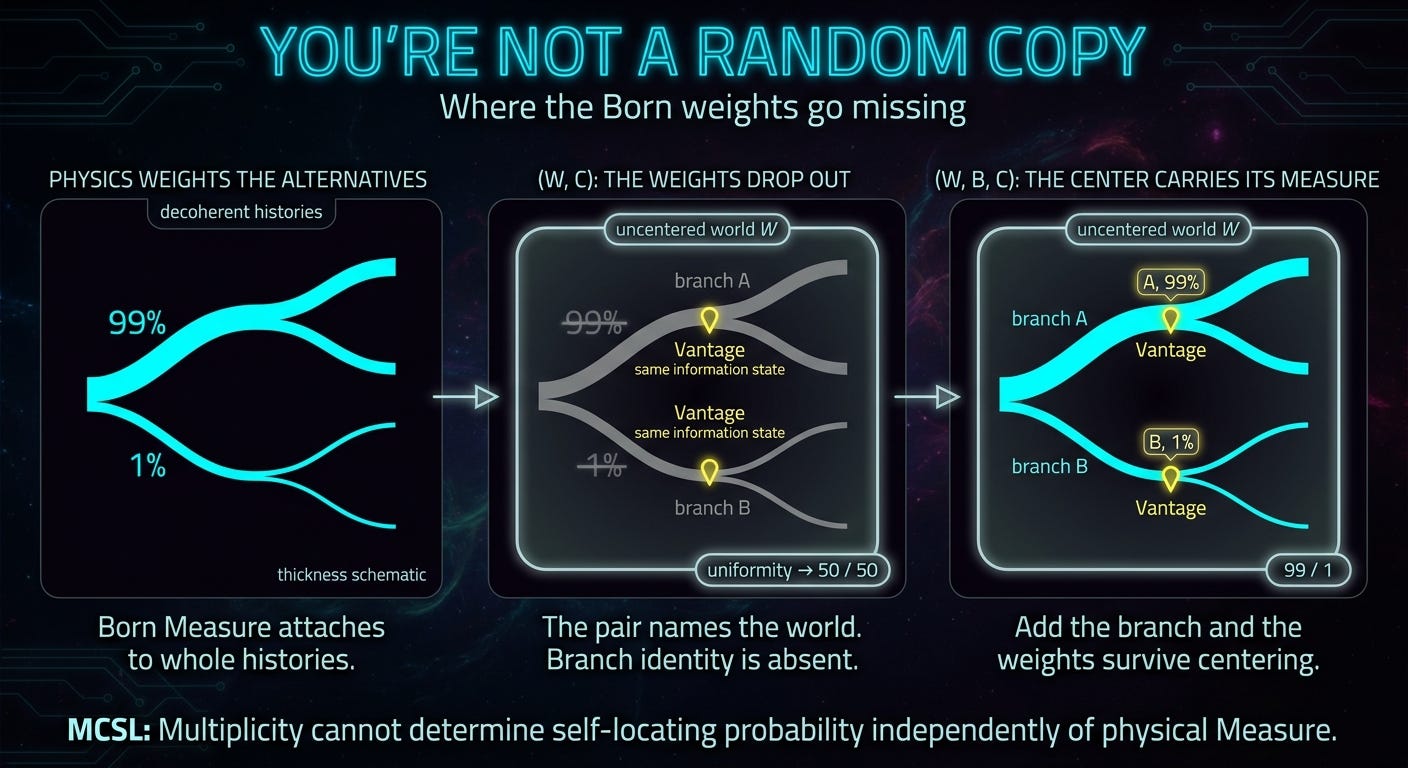
Take an Everettian experiment with two outcomes carrying Born weights of 99% and 1%. Immediately after decoherence, before the observers register their outcomes, there can be versions of the observer holding the same relevant information. Counting those versions discards the amplitude structure that distinguishes the histories supporting them. So
$$\text{same information state} \not\Rightarrow \text{same physical Measure}$$
Information-identical centers need not be physically symmetric. That does not settle anthropic probability. It removes informational identity as a route to the symmetry that equal weighting would require, which reopens the Boltzmann-brain problem.
Vantages, not observer tokens
In the Quantum Branching Universe, a Vantage is the tip of a Branchcone: the physical here-and-now from which decoherent future histories extend. It occupies a definite location in the branching universe.
From a present Vantage V, the Branchcone ℬ(V) contains the represented decoherent histories extending forward from it. Some contain ordinary descendants. Some may contain civilizations that build simulations. If the cosmology permits them, some remote histories contain Boltzmann brains, and among those future Vantages could be observers whose instantaneous information states duplicate the state at V.
Being copies does not make them inadmissible. They are physical situations in the Branchcone. What needs an account is how they enter self-locating probability.
Measure attaches to alternatives, not to occupants
It is tempting to write down a Measure μ(Vᵢ) for every observer and add the numbers up.
Measure does not come in packets attached to observer tokens. In QBU, fundamental quantum Measure applies to events and sets of decoherent histories within a conditioned Branchcone. A Vantage matters because physical histories realize it; its bare existence contributes no unit of probability on its own.
The distinction bites when one history contains many observers. Suppose a history of Measure m contains one observer, and another history of the same Measure contains 10¹⁰⁰ information-identical observers. Nothing in ordinary probability theory says the second history thereby carries 10¹⁰⁰ times the Measure. The two physical alternatives still have Measure m and m. The extra observers are contents of an alternative, not additional alternatives.
Observer counting performs a quiet transformation here. Suppose a single physical world W contains Alice, Bob, and a trillion simulations, all coexisting. The propositions “Alice exists”, “Bob exists”, and “simulation 7 exists” are true simultaneously. Probability Measure is additive over mutually exclusive alternatives, and a universe does not become more probable by containing more rocks, galaxies, or observers.
Centered-world reasoning introduces a different probability space. Instead of treating W as the outcome, it constructs
where each Cᵢ identifies a different center. Those centered propositions are mutually exclusive answers to the question “which center am I?” The construction is legitimate mathematics, and centered-world approaches explicitly model self-locating belief by replacing worlds with world-location pairs or triples. Taylor’s Dutch-book result then places substantial constraints on probabilities over that enlarged space. Copies are therefore not alternative worlds. They become alternative centers once the centered space is constructed.
Physics supplied a Measure over physical alternatives. Centering refined each physical alternative into multiple self-locating alternatives. The probability distribution over those refinements is additional structure. Bayes tells us how to update once a probability space and prior have been supplied; it says nothing about converting coexisting physical systems into equiprobable mutually exclusive possibilities for personal identity. Anthropic assumptions enter with that conversion.
This is the claim of MCSL:
Multiplicity cannot determine self-locating probability independently of physical Measure.
Copies may still matter. If one physical history contains a single Vantage matching your information state while another contains 10¹⁰⁰, and you are uncertain which matching Vantage you occupy, there may be good reason for multiplicity to move centered probability. Taylor’s result is a reason to take that possibility seriously. Across worlds it has the form MCSL demands, since the count of matching centers multiplies a measure over uncentered worlds that the theorem does not supply. Within a fixed world the result is stronger than that. Her weighting is proportional to the measure of the world a center decenters to, so when the centers being compared belong to the same world that measure cancels and the theorem delivers
as a consequence rather than a stipulation. MCSL cannot treat that equation as an unpaid debt. It has to press on the representation instead. The theorem takes as given that the centers sharing your information state are exhausted by pairs (W, Cᵢ), and it says nothing about whether physical structure relevant to self-location survives being packaged that way.
How suppressed a Boltzmann history is
There is a straightforward physical reason to expect histories that produce specified Boltzmann brains to be extraordinarily suppressed. A fluctuation that assembles a highly organized brain out of equilibrium requires an enormous entropy excursion, and statistical mechanics assigns exponentially small probabilities to sufficiently constrained fluctuations.
For intuition only, suppose realizing a specified functional human brain requires constraining roughly 10¹⁵ effectively independent bits. A maximally crude combinatorial model gives a suppression of order
That is not a Born Measure and not a Boltzmann-brain nucleation rate. A real calculation depends on thermodynamics, vacuum structure, temperature, energy, cosmological dynamics, and the physical macrostate that has to be reproduced. Treat the exponent as scale-setting rather than as a result. A suppression of order
is the kind of factor by which physical weighting can diverge from cardinality.
Where the factor acts requires care. It governs how much weight a Boltzmann-brain-producing history receives, which is a fact about the measure over histories. Once a history containing 10¹⁰⁰ Boltzmann brains is fixed, the cost of nucleating them has already been paid inside the weight of that history, and charging it a second time against the centers inside would double-count. Suppression bears on P(W). How centered probability distributes among the Vantages a fixed W contains is a separate question, and exponential suppression answers none of it.
Measure is not one monolithic quantity
Born Measure, thermodynamic fluctuation probability, BB nucleation rate, and cosmological cutoff measure are not interchangeable quantities. At the fundamental QBU level the natural candidate is quantum Measure over decoherent histories. Statistical-mechanical probabilities and fluctuation rates should emerge from quantum dynamics applied to macroscopic states. Cosmology introduces further complications, since infinite spacetime volumes and recurrence can make naive ratios divergent.
Schematically:
quantum state + dynamics → Born Measure over histories → statistical and cosmological rates → self-locating predictions.
The later stages are not presently solved in general. So when this essay speaks of Measure, it is not assuming that entropy, spacetime volume, and Born weight are secretly the same mathematical object. It is making a methodological claim: self-locating probabilities should ultimately be constrained by whatever objective weighting the relevant physical theory supplies. Where that weighting is unknown, the answer is unknown, and observer counting does not fill the gap.
Infinity does not rescue counting
An eternal or sufficiently long-lived universe may provide unlimited opportunities for rare fluctuations. Given enough time, even absurdly improbable events occur. But
infinitely many Boltzmann brains exist
does not imply
Boltzmann brains have greater Measure.
The cosmological literature already demonstrates the problem. Eternal cosmologies can produce divergent populations, and a measure prescription is needed before ratios become meaningful. Cardinality supplies no such prescription. An infinite set of matching Vantages is not a probability distribution.
MCSL does not solve the cosmological Measure Problem. It says that the Measure Problem cannot be solved by replacing an unknown physical weighting with observer cardinality. Ignorance of the correct Measure is ignorance, not evidence for uniform observer weighting.
Causal history enters through physics
An ordinary observer and a Boltzmann brain could have identical instantaneous brain states while being reached through radically different physical histories. The ordinary history looks schematically like
early universe → stars → Earth → evolution → observations → ordinary Vantage
and the Boltzmann history like
equilibrium → rare fluctuation → BB Vantage.
At the tips, the information states may coincide. The physical weights of the histories are fixed elsewhere.
Causal history therefore acquires a role without any special epistemic category of “genuine” memories. Ordinary observers get no bonus because their memories deserve to count, and Boltzmann brains are not ruled inadmissible because their memories are fake. Causal history matters because physical dynamics distinguishes histories:
causal history → physical dynamics → physical weighting → self-location.
There is no teleological step.
This also dissolves an awkward boundary problem. Start with a brain fluctuating into existence, then enlarge the fluctuation: brain, brain plus room, city, Earth. Suppose the fluctuation eventually creates an Earth one billion years ago in just the right state, after which ordinary physical processes produce evolution, civilization, and us. Are we still Boltzmann brains?
The label has stopped doing work. Our recent memories would have been produced by the events they represent, and we would be ordinary observers descended from an extraordinarily improbable earlier fluctuation. MCSL needs no semantic boundary between “real observer” and “Boltzmann brain.” These are different physical histories with different dynamical weights, and physics does the bookkeeping even where we cannot yet complete the calculation.
Simulations are physical processes
The simulation argument raises the same issue, with one complication: simulated observers are not causally identical to biological ones.
Suppose a post-human civilization constructs a computer and runs 10³⁰ perfect simulations of Earth from the Big Bang onward, each eventually containing an informational duplicate of you. From inside a simulation, the represented history may be indistinguishable from ours:
Big Bang → stars → Earth → evolution → you.
Its realizing physical history is different:
base universe → civilization → computer → computation → simulated Vantage.
The represented history and the realizing history must not be conflated. A simulation can represent a universe containing enormous spacetime volume, entropy, and quantum amplitudes without creating those quantities as physical Measure in the base universe. Running a numerical model of a 99/1 quantum experiment does not manufacture additional Born Measure in the ratio 99/1 merely because those numbers occur inside the computation. Computational processing generates no fundamental Measure.
The hard question survives. If one substantial-Measure physical history contains 10³⁰ distinct conscious computations and one biological observer with a matching information state, how should those Vantages enter self-location? Conditional on that history, centering uniformity answers 10³⁰ to one, and nothing established so far blocks the answer. Physics gives us the history and its Measure. Centering gives us multiple locations within it. The rule connecting the two still requires justification.
The copy machine
A simpler thought experiment isolates the issue.
At noon, Alice is biological and unique, and she knows this with certainty. At 1 p.m., a machine creates 10³⁰ exact simulations of Alice’s noon information state. Afterward there are overwhelmingly more simulated Alice-states than biological ones. Does that make the proposition
The Alice who existed at noon was simulated
overwhelmingly probable?
No. The later copies cannot change the physical history that produced the noon Vantage.
Now move the copying event backwards, so that the simulations were created yesterday instead. Pure copy counting now wants their multiplicity to bear on Alice’s present self-location. Why should crossing Alice’s temporal location transform copy number into evidence?
There may well be a legitimate self-location problem after duplication, and MCSL does not deny it. The thought experiment establishes one thing: copy creation and probability creation are not the same operation. The centered probability problem appears only when we additionally ask which of the coexisting Vantages is ours, and that question needs its own account.
The structural similarity between the two arguments is now visible. The Boltzmann-brain argument runs from many matching fluctuations to a high probability that I am one of them. The simulation argument runs from many matching simulations to a high probability that I am one of them. In both cases the premise concerns multiplicity and the conclusion concerns centered probability. If the bridge is
then observer counting has been assumed rather than derived. Perhaps a correct theory will make multiplicity relevant. Perhaps it will reproduce SIA-like weighting under some conditions and fail to under others. The result should be derived from the relation between physical Measure and centered uncertainty, not stipulated by counting observer tokens.
FNC moves the multiplicity
Full Non-indexical Conditioning avoids explicitly sampling an observer. It conditions instead on the existence somewhere in the universe of someone possessing your complete memories.
That eliminates the reference-class problem while making multiplicity relevant in another way, since larger universes provide more opportunities for some observer to instantiate the specified information state. The conditioning proposition becomes approximately
Someone somewhere has these memories,
which is not obviously identical to the evidence available from this Vantage. FNC relocates the underlying issue rather than removing it. Matching information states elsewhere become relevant because the evidential proposition has been transformed into a global existential claim. MCSL asks instead how physical Measure and centered uncertainty combine at the Vantage.
What centering uniformity gets right
Centered uncertainty is real. After an Everettian split, before an observer registers the result, there is a genuine self-locating question. Sleeping Beauty likewise wakes knowing the experimental protocol while lacking information about her temporal location. Taylor’s framework treats centered worlds as an uncentered physical history plus a “here and now” tag and derives constraints on probability policies over those centers, which addresses a real problem.
Taylor’s theorem does more than license uniformity. It supplies a combination rule: weight uncentered worlds by a measure, weight each world by how often your information state occurs in it, then spread uniformly across the matching centers. What it leaves out is the measure. Taylor is explicit that the uncentered measure need not be read as a prior over universes, and that it parameterizes the Dutch-book-resistant policies in the way a subjective prior parameterizes Bayesian updating.
MCSL applies at that gap. A decision-theoretic argument fixes the shape of the combination and leaves its physical content open, and a free parameter invites cardinality to fill it. Where two centers are genuinely symmetric under all relevant physical structure, uniformity is appropriate, and what informational symmetry cannot do is establish that physical symmetry. A physical theory gives us weighted alternative histories, and centering refines those histories into possible locations within them.
Centering symmetry should operate within, rather than replace, the objective weighting supplied by physics.
Taylor also sets quantum mechanics aside by hand. An uncentered world in her setup is an objective state-trajectory of the material universe, with the quantum complications declared out of scope. A branching ontology bites at exactly that exclusion.
Return to the 99/1 experiment. Two post-decoherence centers hold matching information states, and the framework offers two readings of which uncentered world each of them decenters to. Neither reading produces Born weighting on its own.
Read the entire wavefunction as the single uncentered world, and both centers decenter to the same W. Uniformity applies directly and assigns them equal probability. The Born weights appear nowhere, because nothing in the representation records which branch a center inhabits.
Read each decoherent branch as its own state-trajectory, and the Born weights land in the uncentered measure, where the theorem leaves them free. Dutch-book resistance is satisfied by any measure at all, including one that gives the 1% branch more weight than the 99% branch.
MCSL’s demand becomes specific here. A center in a branching universe carries branch-relative structure that the pair (W, C) discards, so a quantum generalization of centered worlds has to retain it, in something closer to (W, B, C) where B is the branch or event whose Measure the center inherits, together with an argument that the measure over branches is Born rather than arbitrary. Whether that generalization goes through is open. What the classical theorem settles is that centering uniformity is complete for uncentered worlds in Taylor’s sense and silent about the structure a measure-bearing branching ontology adds below them.
The open work has moved. What needs deriving is a center that carries its Measure with it, and an identification of the uncentered measure with a weighting the physics supplies.
The remaining debt
This essay does not solve the Boltzmann-brain problem. It identifies a mistake in one purported route to the problem: treating observer cardinality as though it were already a probability measure.
Nor does MCSL solve the cosmological Measure Problem. Born Measure gives us unusually firm footing for quantum alternatives, while eternal cosmology introduces unresolved questions about regularization, recurrence, vacuum dynamics, and observer realization.
There is also an unresolved problem closer to home. Suppose a single physical history of substantial Measure contains 10¹⁰⁰ information-identical Vantages. Taylor’s framework already offers a candidate answer, since the count of matching information states enters as a multiplicative weight on the world, which is SSSA together with SIA up to a population scaling factor. That answer carries a decision-theoretic argument behind it, so MCSL has to meet it on those terms. MCSL objects to cardinality standing in for the measure over worlds, and a count that multiplies such a measure is a different object, one that survives everything argued above.
Which of the two the physics licenses is open. Taylor’s result is itself agnostic between SSSA and SSSA plus SIA, since the difference is a scaling factor that the free measure absorbs. Treating 10¹⁰⁰ coexisting Vantages as 10¹⁰⁰ independent units of physical Measure is still wrong, since they coexist within one physical alternative. Whether they should enter as a population factor on that alternative is the question the free parameter leaves standing.
The problem in its cleanest form:
How should objective physical Measure over histories induce probability over centered refinements of those histories?
For a branching universe the question has a sharper form. What should a center be, when the physics assigns Measure to structure finer than an uncentered world?
Centered-world theory makes those refinements explicit. Taylor’s Dutch-book argument supplies a combination rule for their probabilities, with the uncentered measure left free. Physics supplies quantitative structure over the underlying histories. A satisfactory anthropic theory must preserve all three.
Postscript
Across the three essays the failure keeps its shape. Anthropic reasoning asks which observer you are, and counting observers produces reference-class and population paradoxes. Everettian quantum mechanics asks which branch-relative situation you occupy, and counting branches discards amplitude structure. Boltzmann brains and simulation arguments ask which matching realization you occupy, and counting copies substitutes cardinality for physical structure.
The correction is not that copies never matter. It is that copy count is not itself a measure theory.
A Boltzmann brain whose state matches yours is real if physics realizes it. A simulated observer running in some base universe is real if the computation runs. Neither acquires a claim on your self-location by existing. Their claim on it would have to come through a rule connecting physical weighting to centered probability, and for a universe whose branches carry Measure, nobody has written that rule down.