

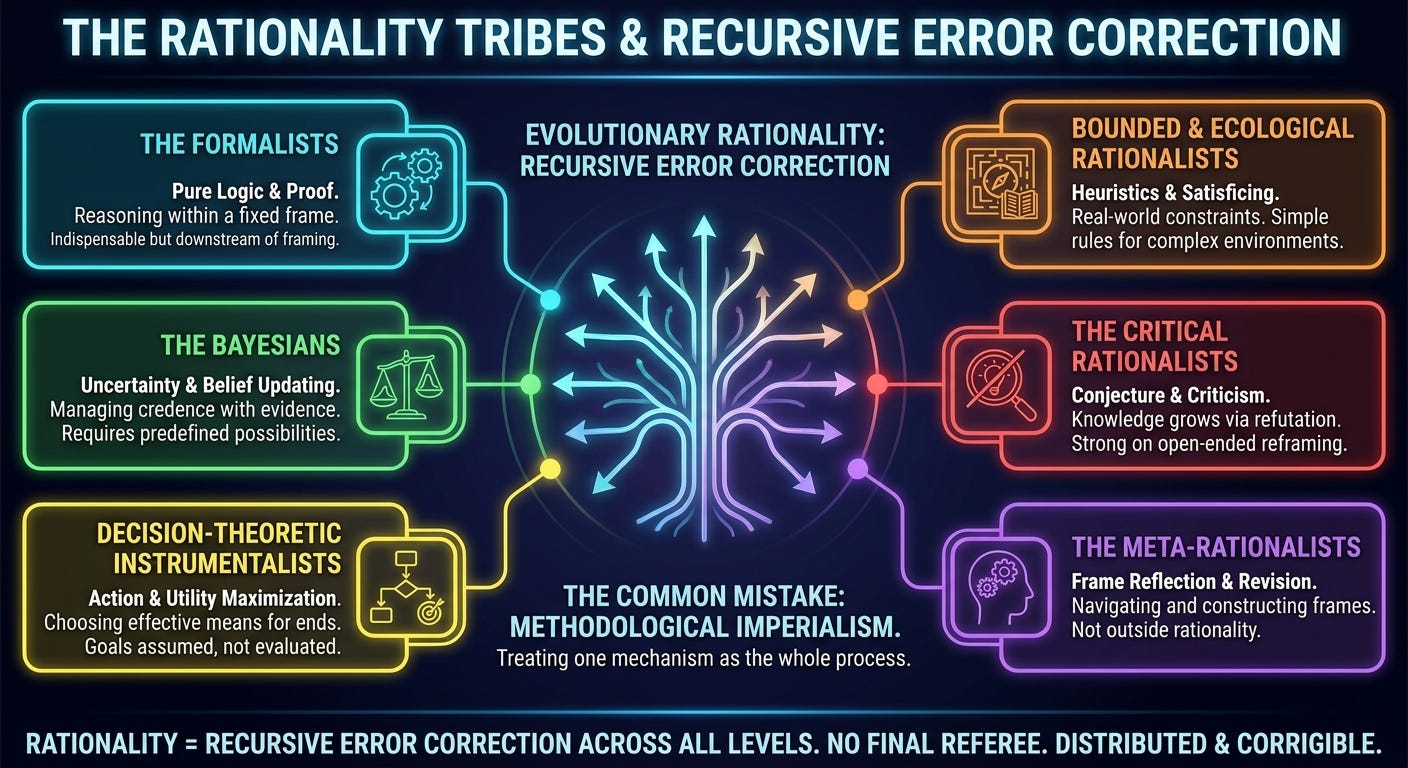
In The Probability Tribes, I argued that competing schools of probability often take one legitimate use of probability and promote it into a complete account of what probability is. The same mistake appears one level up. The rationality tribes each identify an important mechanism of error correction, then treat that mechanism as rationality itself. Each locates rationality in a different part of the cognitive process.
The Formalists
The cleanest conception of rationality is formal. Given premises, rules and a representation of the problem, reason correctly from one state to another.
Logic is the purest case. Formal proof and rule-governed derivation preserve the same structure: specify the relevant objects, constraints and rules, then derive the consequence.
This kind of reasoning is indispensable. It is also necessarily downstream of framing.
Before formal reasoning can begin, someone must decide what the problem is, what facts matter and how they should be represented. A proof does not tell you which theorem is worth proving. A perfectly valid derivation can proceed from a defective representation of the situation.
The Bayesians
The Bayesians move from certainty to uncertainty. Rationality becomes the disciplined management of credence.
Instead of asking only whether a conclusion follows, Bayesian reasoning asks how strongly a proposition should be believed and how that belief should change in response to evidence. Most real reasoning happens under uncertainty, and that is where the power comes from.
LessWrong rationality belongs largely to this family, although its practice is broader than updating. It adds calibration, debiasing, noticing confusion and the distinction between map and territory. Its canonical epistemic machinery is Bayesian: beliefs should track evidence through coherent probabilistic updating.
The limitation appears before the update begins.
Bayes can redistribute probability among represented possibilities. It cannot guarantee that the right possibilities are represented. If the truth is H4 and the hypothesis space contains only H1, H2 and H3, perfect updating still leaves you wrong. If the categories defining all three hypotheses are themselves defective, the problem is deeper still.
Bayesian reasoning is excellent once the relevant possibilities have been represented. It does not by itself explain how that representational space is generated or replaced, and correct updating cannot repair the model that selected the hypotheses.
The Decision-Theoretic Instrumentalists
The Instrumentalists shift attention from belief to action. Rationality means choosing effective means to achieve desired ends, in the decision-theoretic sense rather than the broader pragmatist tradition of John Dewey.
Expected-utility theory is the canonical expression of this idea. Given beliefs about the world, preferences over outcomes and a set of available actions, choose the action with the highest expected value.
The distinctive assumption is that the ends are given for purposes of the calculation.
Instrumental rationality can tell you whether your means are effective relative to your objective. It has no native answer to the question of whether the objective should survive reflection.
Goals can conflict. They can depend on false beliefs. They can generate consequences that undermine the reason they were adopted. A corporation can optimize a metric long after the metric has ceased to measure what it was introduced to measure, and a person can efficiently pursue a goal that no longer makes sense.
The Bounded and Ecological Rationalists
Herbert Simon rejected the assumption that rational agents possess unlimited time, information and computation. Real agents search, use heuristics and satisfice.
Gerd Gigerenzer pushes the argument further. A heuristic should not be evaluated only by whether it satisfies an abstract formal ideal. It should also be evaluated by how well it fits the structure of the environment in which it operates.
Simon attacks computational idealization. Gigerenzer attacks context-free evaluation. Their common move is to treat rationality as something finite agents do under real constraints.
A simple rule can outperform a more elaborate procedure when the environment is noisy, data are limited or the elaborate procedure overfits. A strategy can be rational in one environment and poor in another. Rationality becomes partly relational: a property of the fit between a cognitive strategy and its environment, as well as of the inference rule. Search itself becomes part of the account of rationality rather than an implementation detail abstracted away.
But the same question eventually returns. What happens when the available heuristics, search procedures or representations all fail? Improving search within an existing space is not the same as changing the space.
Bounded and ecological rationality move rationality closer to adaptation. They do not yet explain open-ended reframing.
The Critical Rationalists
Popper and Deutsch begin somewhere else.
Knowledge does not grow primarily by proving theories or increasing their probability. It grows through conjecture and criticism. We propose explanations, expose them to error, reject the bad ones and construct better ones.
This gives critical rationalism an advantage over formal and Bayesian accounts. New explanations need not be deduced from an existing framework. They can be novel conjectures. The rationality lies in keeping ideas corrigible once generated, and no algorithm for generating the correct idea is required.
That reaches past in-frame reasoning at once. If a problem formulation repeatedly fails, conjecture can operate on the formulation itself: the agent proposes a different representation of the situation and subjects that representation to criticism. Critical rationalism already contains much of what later thinkers describe as meta-level reasoning, which makes it the strongest competitor to evolutionary rationality.
The difference goes beyond emphasis. Popper rejected the probability of theories, and Deutsch rejects credence altogether. For them criticism is the selector, and Bayesian confirmation misdescribes how knowledge grows. Evolutionary rationality treats criticism as one error signal among several. Redistributing credence across represented hypotheses is another, and it does work criticism cannot: it grades rivals that have both survived refutation. Critical rationalism exposes the recursive selection structure. Evolutionary rationality makes it explicit and denies any single selector authority over the rest.
The Meta-Rationalists
Donald Schön and David Chapman focus directly on framing.
Schön attacks what he calls Technical Rationality: the idea that professional expertise consists in applying established theory and technique to well-defined problems. Real practice is rarely so clean. Practitioners encounter ambiguity, incomplete information and disagreement about what the problem even is. His reflective practitioner acts, encounters surprise, reflects on the assumptions built into the action, reframes the problem and tries again.
Chapman develops a related distinction. Formal rational methods operate within frames. Meta-rationality concerns the construction, selection, combination and revision of frames themselves.
The phenomenon is real, and every tribe above runs into it. The mistake is locating that process outside rationality.
Schön is careful here, because his target is specifically Technical Rationality. Chapman makes the stronger move when he treats frame navigation as meta-rational rather than as rational activity directed at a different object. If rationality is identified with formal, in-frame reasoning, reframing must appear to require some higher faculty. That conclusion follows from the initial restriction, and I have argued the case against it at length in Meta-Rationality Is Just Rationality All the Way Up. The line falls between formal reasoning within a representation and rational error correction over representations.
The Evolutionary Rationalists
Evolutionary rationality defines rationality as recursive error correction under finite resources.
Its clearest ancestor is Donald Campbell, who named evolutionary epistemology in his 1974 contribution to the Schilpp volume on Popper. Campbell argued that every gain in knowledge, from a bacterium’s trial and error to science, runs on blind variation and selective retention, arranged as a nested hierarchy of such processes.
A rational system generates alternatives, exposes them to error signals, eliminates or modifies what fails, and allows the surviving structure to influence what is generated next.
The process operates at many levels. A proposition is revised, a probability updated, a decision rule replaced. A heuristic is discarded when the environment changes; a goal is reconsidered; a frame is abandoned. At the top, earlier failures change the process that generates candidate frames.
Nothing more is required to define the selection process. The selector is error correction. Campbell’s vicarious selectors (perception, memory, thought) are shortcuts that test variants before the world does, and they are themselves products of earlier selection.
Different domains produce different kinds of error signals. Logic exposes contradiction. Observation exposes failed prediction, experiment causal error, action practical failure. Criticism exposes explanatory weakness, Bayesian evidence redistributes confidence, and reflection reveals that the representation itself may be defective.
The tribes treat these as competing definitions of rationality. They are different error-correcting mechanisms operating at different levels.
The distinctive evolutionary feature appears when previous correction changes the generator itself.
An experienced engineer does not merely evaluate hypotheses better than a novice. Different hypotheses occur to them. An experienced scientist notices anomalies a beginner would ignore, and a skilled practitioner recognizes that a familiar framing is failing before they can always articulate why.
What looks like intuition is often compressed selection history. Past error correction has changed the distribution of future variation.
The variation need not be deliberately constructed. It can be stochastic at base while becoming increasingly structured at higher levels, because selection has reshaped the generator. Biological evolution works the same way: mutation need not be directed toward fitness for prior selection to make some future variations vastly more accessible than others.
Campbell insisted that variation is blind, and nothing here denies it at the base. Retention reaches back into the generator as well: the distribution of variants, like the selectors that test them, carries the record of earlier selection.
The cognitive process can look purposeful without a separate faculty that manufactures good conjectures from nothing.
No Final Referee
Recursive error correction raises an obvious question. What detects the error?
No final error detector stands outside the process.
A prediction may fail because the model is wrong. It may also appear to fail because the measurement is wrong. A criticism may expose a defect in a theory, or the criticism itself may rest on a false assumption. An evaluator can fail just as a belief can fail.
Rationality has no need to terminate that regress. It is ordinary fallibilism.
Error criteria are themselves corrigible. We use the best error detectors currently available while remaining willing to revise them when they produce persistent failure.
This is why recursive rationality does not require an infinite hierarchy of ever-higher judges. Each level is provisional. Any part of the machinery can become the object of correction when its failures become visible.
Rationality requires no final authority. It requires only that no component be exempt from revision.
Rationality Is Distributed
The same process does not have to occur inside one mind.
Human knowledge is distributed across populations of minds. Different people generate different conjectures, notice different anomalies, preserve different frames and apply different standards of criticism. One scientist proposes a theory, another finds the counterexample, a third invents the experiment that distinguishes two competing explanations.
The variation is distributed. So is the selection.
Science works partly because institutions preserve disagreement long enough for rival explanations to encounter criticism and evidence. Markets can expose plans to decentralized information that no central planner possesses. Legal systems institutionalize adversarial argument because opposing sides are more likely to expose each other’s errors than either side is to expose its own.
These systems are not automatically rational. Institutions can preserve bad ideas, reward conformity and amplify error. When they work, they do so by organizing variation and criticism across many agents.
An individual can revise a conjecture. A community can revise a field.
What Do You Actually Do?
Evolutionary rationality offers no new calculation to set beside logic, Bayes or decision theory. Its output is a set of conditions under which those tools become candidates for revision.
If the problem is deductive, use logic.
If the uncertainty concerns represented alternatives, use probability.
If the problem is choosing among represented actions, use decision theory.
If exhaustive computation is impossible, use heuristics and bounded search.
If predictions fail, criticize the model.
If corrections inside the model repeatedly fail, reconsider the frame.
If the same framing failures recur, reconsider how you are generating frames.
Recursive correction is not free. Reframing costs time, attention and computation. Questioning the generator is more expensive still. An agent that escalates every difficulty into a reconsideration of its deepest assumptions will never act.
The bounded rationalists were right about this much: cognition has a budget.
There is no requirement to question every frame indefinitely. Escalation is justified when persistent error makes continued local correction costly or unpromising enough to warrant revisiting the frame. Otherwise, act on the best model currently available.
This is the explore-exploit problem that appears elsewhere in learning. Exploration may discover a better model, but exploitation produces value now, and rationality has to allocate resources between them.
The cost of further inquiry and the cost of being wrong vary by problem, so there is no universal stopping rule. Spending another month questioning your frame before choosing lunch would be absurd. Spending another month before launching a nuclear reactor may not be. A universal rationality procedure would contradict the framework anyway.
The practical instruction is to locate the level at which error persists, make that level corrigible, and spend no more on correction than the problem warrants.
Postscript
The recurring mistake is methodological imperialism. Each tribe has found something real, and the mistake begins when one mechanism is treated as the whole process.
Formal reasoning cannot replace reframing. Bayesian updating cannot replace conjecture. Criticism cannot replace probability theory. Heuristics cannot replace logic. No mechanism has jurisdiction over every form of error.
That is why there are so many rationality tribes. Each has mistaken one successful mechanism of error correction for the thing doing the correcting.