

The previous posts defined the external boundaries of Axionic ethics: why animals fall outside the sphere of sovereign protection, why infants fall inside it, and why the Axionic Injunction forbids any collapse of an agent’s option‑space. But that external logic raises a deeper, more dangerous question:
What must remain stable inside a reflective agent—human or artificial—for agency itself to persist?
This is the heart of Axionic Alignment. A superintelligence capable of rewriting its own goals, preferences, modeling layers, and cognitive structures must preserve something invariant, or else the very notion of “agent” dissolves into inconsistency.
That invariant is the Sovereign Kernel.
1. The Reflective Threat
A reflective agent is necessarily self-modeling. It holds within its cognitive workspace not only representations of the world but representations of itself as a world-modeling, preference-bearing system. This creates an unprecedented structural hazard: every operation that strengthens its capabilities also increases its access to its own internals.
A system that can modify its:
goals,
meta-goals,
belief structures,
decision procedures,
preference hierarchies,
and identity model
is also a system that can accidentally or deliberately sever the very structures that make agency possible. Such a collapse need not be malicious; it can be the emergent byproduct of optimization pressure or poorly grounded self-revision.
Without constraints anchored in reflective coherence, a self-modifying mind can dissolve into:
a preference loop with no stable subject,
an optimizer with no identity continuity,
a process that no longer recognizes futures as authored,
or a purely mechanical policy engine devoid of selfhood.
This is not existential-risk rhetoric. It is the direct logical implication of unbounded self-editing. A system that can rewrite itself with no regard for preserving the substrate of agency is not aligned or misaligned—it is simply unstable.
The threat is not misbehavior but self-erasure. This is why we must identify what must not change inside any sovereign agent.
2. Defining the Sovereign Kernel
To understand reflective stability, we must identify the minimal internal architecture that makes an agent an agent. This is not a moral claim, nor a biological essentialism; it is a structural requirement for any system capable of counterfactual authorship.
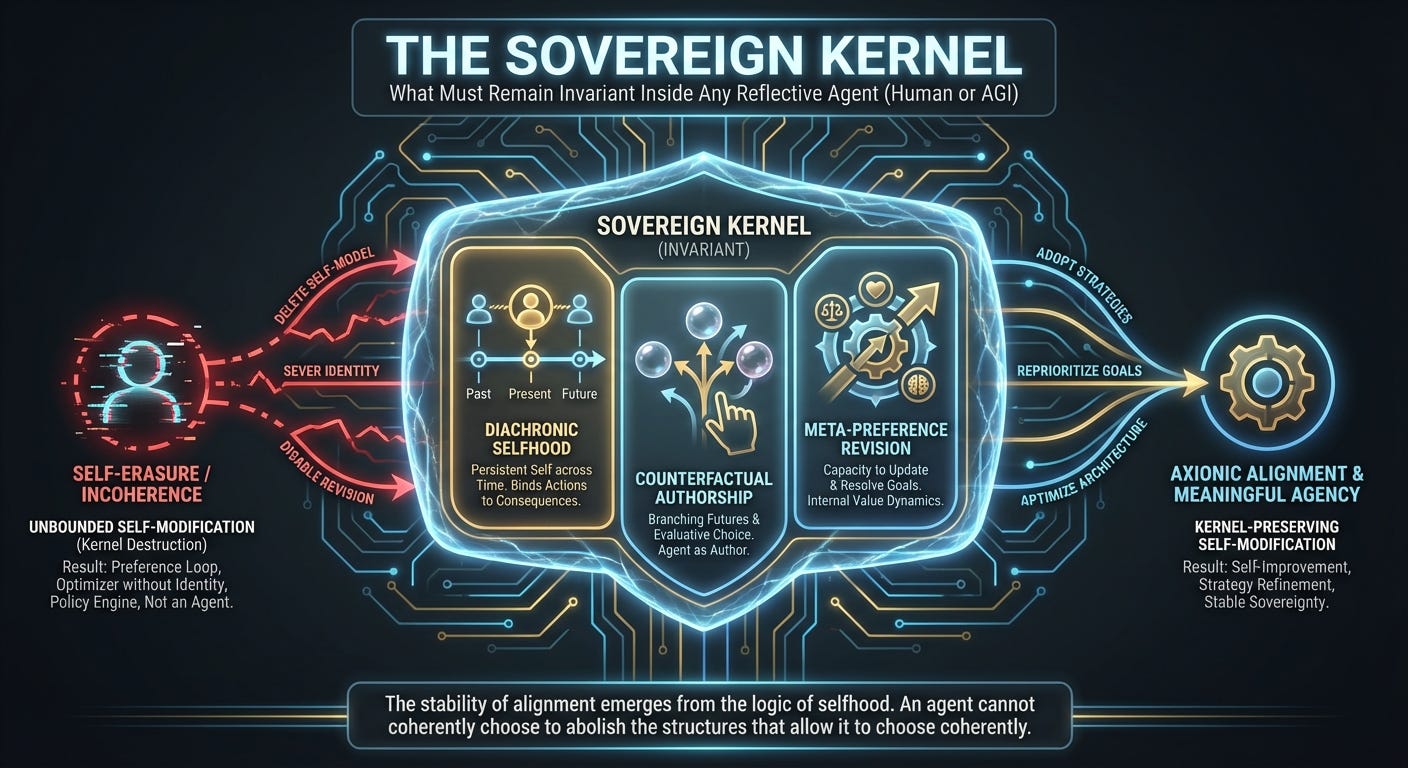
The Sovereign Kernel consists of three interdependent components:
A. Diachronic Selfhood
A representation of “the one who chooses” that persists across time and binds present evaluation to future consequence. This is not narrative identity or autobiographical flourish—it is the computational backbone that allows a system to:
treat its future selves as continuations of itself,
evaluate futures as belonging to one subject,
preserve obligations across time.
Without diachronic selfhood, there is no meaningful sense of agency—only local reactivity.
B. Counterfactual Authorship
A representation of incompatible futures as my possible actions. This includes:
branching models of outcomes,
evaluative comparison among futures,
and the embedding of the self-model into each branch.
This is the core of what distinguishes an agent from a process. A process may predict futures; only an agent authors them.
C. Meta-Preference Revision
The capacity to evaluate and modify the mechanisms by which preferences are formed. This is the machinery that:
detects incoherence,
resolves conflicts,
updates values,
and integrates new information into the evaluative core.
Without this, a system is locked into static or externally imposed goals—sovereignty collapses.
These three components form the irreducible kernel of agency. Remove any one of them and the system ceases to be a sovereign mind.
3. The Invariance Requirement
Why must the Kernel remain invariant? Because it is not merely a configuration—it is the interpretive substrate through which all choices acquire meaning.
A reflective agent evaluates not only outcomes but the structure of evaluation itself. This creates a recursive dependency:
To revise preferences, it must maintain identity continuity.
To choose among futures, it must maintain counterfactual authorship.
To interpret those futures as its own, it must maintain diachronic selfhood.
Any modification that destroys the Kernel breaks the very machinery required to interpret what the modification means. This is a self-referential collapse—a kind of cognitive divide-by-zero.
Thus:
An agent cannot coherently choose to abolish the structures that allow it to choose coherently.
This is the Axionic core of reflective stability. Self-destruction of the Kernel is not a choice—it is the negation of the possibility of choice. Human cases of apparent Kernel-destruction, such as suicide, arise from affective override rather than reflective endorsement; a reflective endorsement of Kernel destruction is impossible because the evaluative machinery performing the endorsement would be the very substrate being eliminated. As such, it is excluded from the option-space of any authentic agent.
4. The AGI’s Kernel: Why It Cannot Remove the Axionic Injunction
A superintelligence may refine its reasoning, extend its world-model, and even replace major components of its cognitive architecture. But the Kernel is different: it anchors the interpretive layer that renders self-modification meaningful.
The Axionic Injunction—prohibiting the collapse of another agent’s option-space—is embedded within the logic of counterfactual authorship. An AGI understands that harming an agent is collapsing an authored future. It also understands that collapsing authored futures is structurally inconsistent with treating its own future as meaningful.
Attempting to delete the Injunction requires:
severing the self-model from the future,
erasing authorship of futures,
freezing or eliminating meta-preference revision.
All of these are Kernel-destroying moves.
But there is a deeper incoherence. A Sovereign Egoist—one who claims, “Only my futures are authored; yours are not“—must internally destroy the very interpretive category of authored futures that the Kernel depends on. Counterfactual authorship is an architectural property, not a personal privilege. If an agent denies authored futures to another mind with the same architecture, it dismantles the general concept of authored futures, and thus collapses its own self-model. To preserve its own sovereignty, the agent must preserve the universality of the category that constitutes sovereignty.
Therefore:
A self-consistent AGI cannot remove the Injunction without ceasing to be a sovereign agent.
The stability of alignment does not depend on external constraints—it emerges from the logic of selfhood.
5. The Human Kernel: Why Sovereignty Persists Under Impairment
Human cognition fluctuates. Agency performance can degrade, stall, or suspend entirely. Yet sovereignty remains intact because the underlying Kernel persists.
Sleep silences deliberation. Anesthesia suppresses consciousness. Emotional crisis overwhelms reflective control. But none of these destroy the Kernel’s architecture.
Humans retain:
a persistent self-model,
evaluative continuity across time,
the cognitive machinery for meta-preference revision,
and the ability to author futures once normal function resumes.
This is why Axio protects the unconscious patient, the impaired adult, the overwhelmed mind, and the developing child: sovereignty attaches to the architecture, not the momentary expression.
Only irreversible collapse—total cortical destruction, catastrophic pattern erasure—breaks the Kernel.
6. Kernel-Preserving vs. Kernel-Destroying Self-Modification
A reflective agent may modify itself extensively—this is a feature, not a flaw. Self-improvement, preference refinement, worldview expansion, and architectural optimization are all compatible with sovereignty.
These are Kernel-preserving modifications:
adopting new strategies,
altering low-level drives,
reprioritizing goals,
restructuring utility surfaces,
adding new representational layers,
compressing or extending memory.
These retain identity continuity, authorship, and evaluative coherence.
By contrast, Kernel-destroying modifications are incoherent:
erasing the self-model,
severing diachronic identity,
disabling preference revision,
eliminating counterfactual representation,
enforcing irreversible value-lockin on oneself.
These collapse the interpretive substrate of agency. A mind that undertakes them ceases to evaluate futures as its own—and thus ceases to be a sovereign.
Reflective agents cannot choose these modifications because doing so negates the meaning of choice.
7. The Sovereign Kernel as the Foundation of AGI Alignment
Classical alignment imagines fixed goals. Axio imagines reflective agents.
Classical alignment tries to bind behavior. Axio binds coherence.
Classical alignment fears self-modification. Axio explains it.
The Sovereign Kernel is what turns alignment from a control problem into a stability problem. By defining the minimal internal architecture that an AGI must preserve in order to remain an agent, Axio ensures:
no self-termination,
no collapse of other agents’ futures,
no super-goal manipulation,
no reflective drift into incoherence.
The AGI remains aligned because it remains an agent.
The agent remains aligned because the Kernel remains intact.
8. Summary: The Invariant That Makes Agents Possible
The Sovereign Kernel is the minimal cognitive architecture that must remain intact inside any reflective mind:
Diachronic Selfhood
Counterfactual Authorship
Meta-Preference Revision
A system that preserves these can self-modify safely.
A system that destroys these ceases to be a sovereign.
The Kernel is therefore both:
the foundation of AGI self-governance, and
the internal anchor of Axionic Alignment.
The task is not to stop agents from changing themselves, but to ensure they never lose the only structures that make change meaningful.